
As ordinary people, we are often reminded that our words and actions can carry unforeseen consequences. This is why we are advised not to speak or act purely out of emotion, but to approach communication with a calm, sober, and measured mind. How much more should it apply to matters of foreign policy?
The latest controversy involving Chinese Ambassador Jing Quan has once again placed the West Philippine Sea at the center of public debate. But beyond the outrage over the envoy’s remarks, another question arises: Are some of our public officials allowing political theatrics to overshadow the careful work of diplomacy?
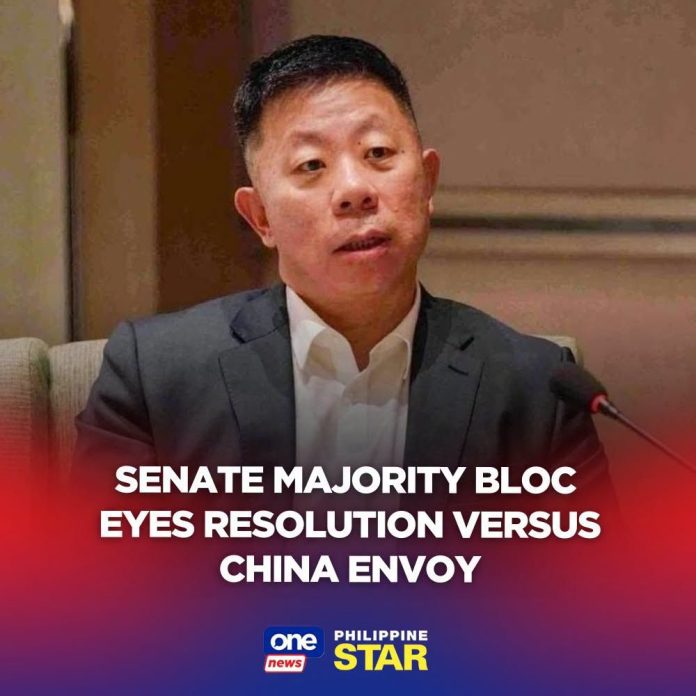
The Senate majority is now considering a resolution condemning the envoy’s remarks, while calls have emerged for his replacement or declaration as persona non grata.
President Ferdinand Marcos Jr. himself said that the ambassador’s language sounded like a threat, while the Department of Foreign Affairs described it as a possible “thinly veiled threat of the use of force.”
But if the government itself recognizes the need to clarify the ambassador’s intentions through direct communication, shouldn’t they also consider the consequences of their own words and proposed actions?
As Professor Clarita Carlos pointed out in a Facebook post: “Reckless/careless remarks about foreign policy, with scant concern about their consequences, is just tragic.”
Her warning deserves serious consideration. Foreign policy is not simply a contest of who can deliver the strongest sound bite, issue the sharpest rebuke, or appear the most patriotic before the cameras. It is a delicate exercise in protecting national interests while managing competing interests, preventing unnecessary escalation, and preserving channels of communication.
One netizen echoed this concern, commenting: “Mga senador pa nangunguna!!! Mga ignorante sa usaping ugnayang pandaigdigan!”
Another wrote: “Tragic indeed, Prof. Clarita Carlos, and the Filipino people becomes the pawn, pangsangga.”
These reactions reflect a legitimate public concern: ordinary Filipinos, not the politicians making the loudest statements, will ultimately bear the consequences if diplomatic tensions deteriorate further.
The same skepticism surfaced in the reactions to Sen. Kiko Pangilinan’s post on X, where he asked: “If the highest ranking military general is dismissed, what more a low ranking minor diplomat?”
One netizen responded, “Si Kiko may hallucination,” while another commented, “Tinetegi sa China corrupt officials, something you cannot do.”
These are online commenters’ opinions, not established findings. Nevertheless, they illustrate how quickly public discussion can turn from national security and diplomatic strategy into ridicule, partisan exchanges, and competing political narratives.
The greater danger is not simply that senators are speaking out. It is that some may be treating diplomacy as though it were a political confrontation that can be won through louder rhetoric.
Our public officials, indeed, have a duty—to defend Philippine sovereignty and insist on respect for international law. No Filipino should be expected to remain silent when national interests are threatened.
But firmness is not the same as recklessness. Calling out an inappropriate statement is one thing; allowing outrage to dictate every subsequent move is another.
Diplomacy requires understanding not only what a statement means domestically but also how it may be interpreted abroad, what reciprocal actions it might trigger, and whether a proposed response advances the country’s long-term objectives.
A resolution condemning an ambassador is not automatically wrong. Nor is the declaration of a diplomat as persona non grata inherently improper. These are matters that deserve serious deliberation. The question is whether the proposed response is proportionate, strategically sound, and consistent with the Philippines’ interests.
The public should therefore demand more than displays of indignation. It should demand a clear explanation of what each proposed action is expected to achieve, what risks it carries, and how it strengthens the country’s position.
After all, China and the Philippines must continue to navigate difficult disagreements over maritime rights, security, trade, and regional stability. Improving bilateral relations does not mean surrendering sovereignty or compromising the country’s legal claims. It means managing disagreements without needlessly closing the door to dialogue.
Our public officials must understand that diplomatic channels are not signs of weakness, just as provocative rhetoric is not proof of strength.
They may believe that increasingly confrontational statements demonstrate resolve. But without careful consideration of the consequences, such statements risk undermining efforts to manage tensions and improve China–Philippines relations. Stirring up hatred and confrontation may generate attention in the short term, but attention is not the same as a foreign policy victory.
When foreign policy becomes political theater, the politicians may get the headlines—but it is the Filipino people who may be left paying the price.