
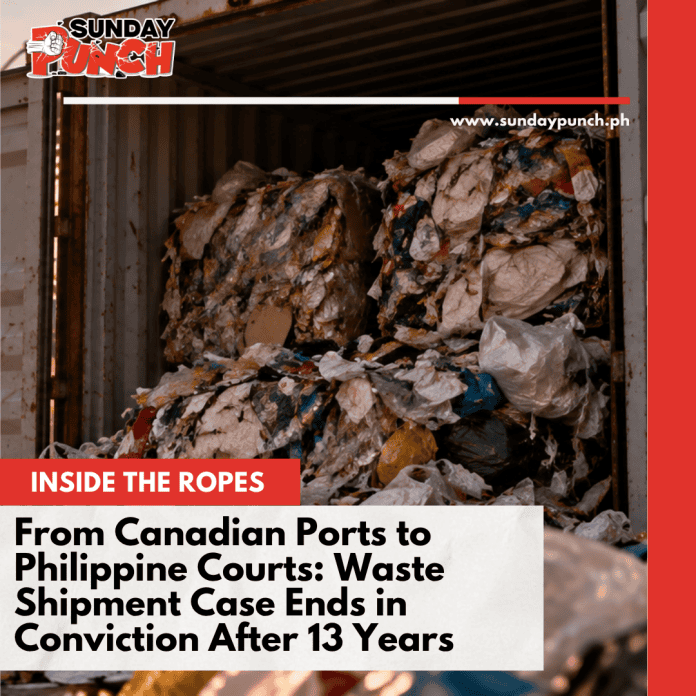
Thirteen years. That is how long it has taken for a Philippine court to deliver a conviction connected to a shipment of Canadian waste that entered the country in 2013. What arrived at the Port of Manila under the description of recyclable plastic scrap eventually became part of an international controversy over the Philippines’ treatment as a destination for foreign garbage. Now, more than a decade later, the Manila Regional Trial Court has found the owner of Chronic Plastics guilty of violating the country’s hazardous waste law. The ruling raises an uncomfortable question about environmental accountability: if improperly imported waste can enter a country in a matter of weeks, why can establishing criminal responsibility take more than a decade? Apparently, unwanted cargo can cross international borders considerably faster than justice can move through a courtroom.
In a decision promulgated on August 26, 2026, Acting Presiding Judge Marlo Magdoza-Malagar found the business owner guilty of violating Republic Act No. 6969, or the Toxic Substances and Hazardous and Nuclear Wastes Control Act of 1990. The court imposed a prison sentence of 12 years and one day to 20 years and a ₱1-million fine. According to the Department of Justice (DOJ), the case involved 10 container vans that arrived on June 23, 2013, carrying materials initially declared as compressed plastic scrap. Inspections revealed mixed, unsorted, and heterogeneous waste materials, while prosecutors presented evidence of discrepancies between the declared contents and the actual shipment. Two customs brokers charged in the case were acquitted after the court found insufficient evidence that they knowingly participated in the unlawful importation. The conviction represents a judicial finding against the business owner, although the available announcement does not establish whether the judgment is already final.
The case traces its origins to a much larger waste controversy involving shipments from Canada. Philippine congressional records show that approximately 50 container vans containing mixed waste, including household garbage and used diapers, arrived between June and September 2013, triggering investigations, diplomatic exchanges, and demands for their return. In 2019, the dispute escalated when then-President Rodrigo Duterte publicly threatened a confrontation with Canada over the unresolved shipments. Canadian authorities subsequently arranged for the return of 69 waste-filled containers that year. The eventual repatriation addressed a major diplomatic issue, but it did not automatically resolve the separate question of legal accountability for those involved in the importation. The distinction matters: returning unwanted garbage and holding responsible parties accountable are two different processes, and this latest conviction demonstrates just how far apart their timelines can be.
The controversy also exposes an imbalance in the international movement of waste. Countries generating large quantities of discarded materials can participate in a global trade in recyclables, but the environmental consequences become particularly serious when shipments are improperly declared or contain materials that receiving countries cannot lawfully process. In the Philippine case, the costs extended beyond the containers themselves to government investigations, storage and disposal concerns, diplomatic negotiations, and years of legal proceedings. Justice Secretary Fredderick Vida welcomed the conviction, emphasizing that environmental protection requires holding accountable those who violate the law for personal gain. His statement reflects a principle that deserves greater attention: the economic value of recyclable materials cannot justify circumventing environmental safeguards. Recycling may be a legitimate industry, but calling something plastic scrap does not automatically make every item inside a shipping container lawful cargo.
Ultimately, the conviction offers an important development in a controversy that began when the Philippines was left confronting waste originating thousands of kilometers away. It also raises broader questions about customs enforcement, environmental regulation, and the ability of institutions to deliver timely accountability. The Philippines should be able to participate in legitimate international trade without becoming a destination for improperly declared waste, just as foreign exporters and local importers must comply with applicable environmental laws. A prison sentence and fine may send a warning to those considering similar violations, but preventing another incident requires effective oversight long before containers reach Philippine ports. Thirteen years after the shipment arrived, the country has obtained a conviction. The more important test is whether the lessons from this case can help ensure that the next shipment of foreign garbage is stopped before it becomes another decade-long national problem.