
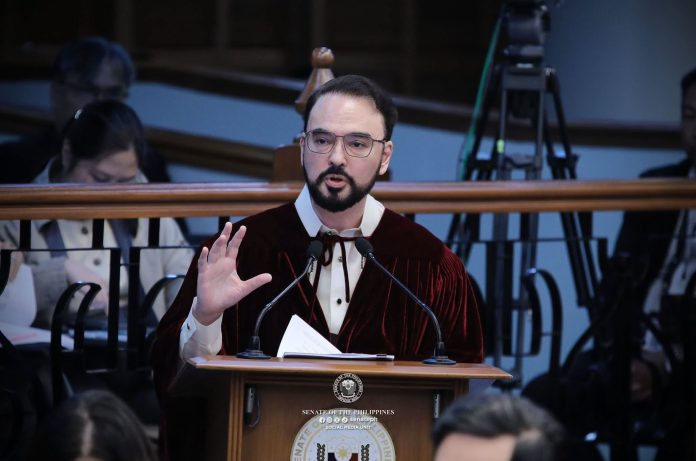
Senate Minority Leader Alan Peter Cayetano on Friday pushed for the inclusion of sports, art, and culture in the government’s Cabinet cluster for education, seeking to give these sectors a greater role in shaping the country’s education and workforce development policies.
During the Senate’s October 16 budget briefing for the Department of Education (DepEd), Cayetano stressed the importance of sports and art in the holistic development of students and in creating more economic opportunities for Filipinos locally and abroad.
“Let me lobby that sports and culture and art be included because it’s really as much a part of our education as anything else, as math and everything,” he told Education Secretary Sonny Angara.
Cayetano described sports and art as the “soul” of education, noting their role in teaching Filipino students valuable life skills that cannot be developed through academics alone.
“In sports, tinuturo sa’yo na kahit lahat ng points sa’yo [individually], kung madupang ka naman at talo naman y’ung team mo, bale wala… [In art and sports you also learn] problem-solving, creativity,” he said.
The Education and Workforce Development Group was established in August 2025 to coordinate the country’s education and employment policies. It is currently composed of eight agencies, including DepEd, Commission on Higher Education (CHED), Technical Education and Skills Development Authority (TESDA), Department of Labor Employment (DOLE), and Department of Migrant Workers (DMW).
Cayetano was among the major proponents of the Cabinet cluster, having co-authored a resolution seeking its creation in 2024 as co-chairperson of the Second Congressional Commission on Education (EDCOM II).
He had specifically pushed for the involvement of labor and budget agencies to ensure that education reforms would respond to workforce needs and receive sustained funding.
Opening doors for Filipino artists
Beyond developing students’ character and talents, Cayetano also urged the education cluster to explore the economic potential of Philippine art by helping more Filipino artists find their “big break” in the international market.
He called for closer cooperation among DepEd, National Museum, and the Department of Foreign Affairs (DFA) to promote Filipino artists abroad and help them overcome barriers to international exposure.
He cited difficulties faced by artists in securing permits to bring their artworks overseas for exhibitions and subsequently return them to the Philippines.
“Ang dami nating aspiring artists, breakthrough lang (ang kailangan)… and then, really, someone to champion it,” he said.
Cayetano, who was DFA chief from 2017-2018, himself initiated “soft diplomacy” efforts in which the agency would actively look for an industry or “some kind of breakthrough where Filipinos can make it big abroad.”
His advocacy for the arts also extended to his term as House Speaker, during which the chamber created the Special Committee on Creative Industry and Performing Arts in 2020. He also proposed establishing a Department of Arts and Culture to strengthen government support for Filipino artists and promote their work internationally.
In the hearing, Cayetano pointed out that while the Philippines continues to face stiff competition in manufacturing and other industries, Filipino artists have the potential to succeed globally through their creativity and talent.
“The beauty about art is you don’t need to manufacture anything here. You don’t need to import anything from there. It’s the talent of the artist,” he said.
Angara agreed and said they would work on the senator’s suggestions, adding that EDCOM had already initiated discussions with prominent Filipino artists, including Patis Tesoro and Manny Garibay, to improve DepEd’s art curriculum.###