
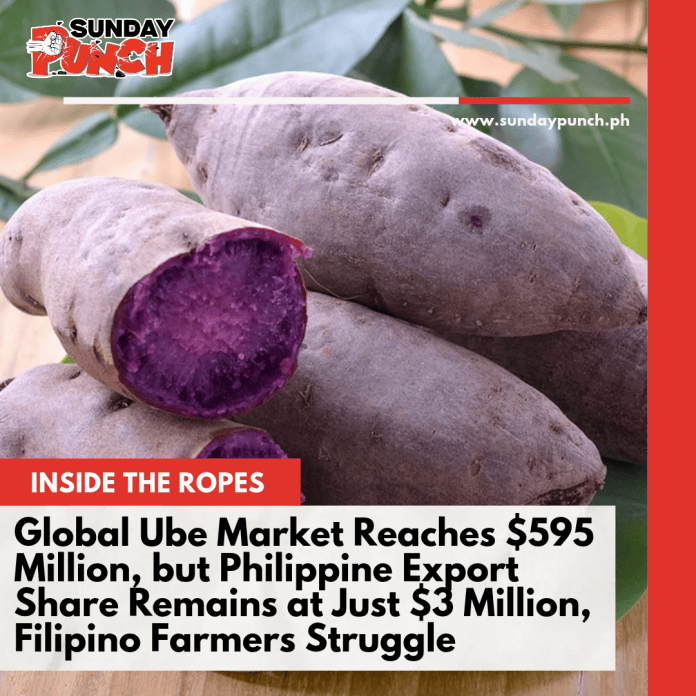
Ube may be gaining worldwide popularity, but Filipino farmers are capturing only a fraction of its growing international market. According to Chester Velasco, president of the United Ube PH Federation, the global ube market was valued at approximately $595 million in 2025, while Philippine exports accounted for just $3 million. Velasco raised concerns that neighboring countries, particularly China and Vietnam, are expanding their own purple yam production using varieties obtained from the Philippines. He also alleged that some foreign-grown ube products are being marketed as Philippine ube, raising questions about product authenticity and the country’s ability to protect its agricultural identity as international demand increases.
The industry’s challenges extend beyond foreign competition. Local growers continue to struggle with limited planting materials, unstable farmgate prices, and inadequate access to reliable buyers, preventing them from expanding production despite growing demand. Velasco cited cases in Romblon where farmers reportedly sold ube for as little as ₱20 to ₱40 per kilogram, discouraging some from planting again. To address these problems, the federation is promoting contract-growing arrangements that provide agreed purchase prices and more predictable markets. Meanwhile, the Department of Agriculture (DA) has suspended exports of fresh ube and planting materials to preserve local supplies, while allowing processed products such as ube powder, extracts, and halaya to continue reaching international markets.
Efforts to strengthen the Philippine ube industry are now receiving additional financial support. The United States Department of Agriculture has awarded $34.1 million for a five-year development program expected to benefit more than 12,500 Filipino farmers, with nonprofit organization TechnoServe implementing the initiative. The assistance complements a separate ₱300-million Philippine government program aimed at expanding cultivation and improving production capacity. However, funding alone will not guarantee a larger share of the global market. For Filipino growers to benefit from ube’s international popularity, the industry must improve access to planting materials, strengthen product certification and processing, and establish dependable markets that allow farmers to earn sustainable incomes.