
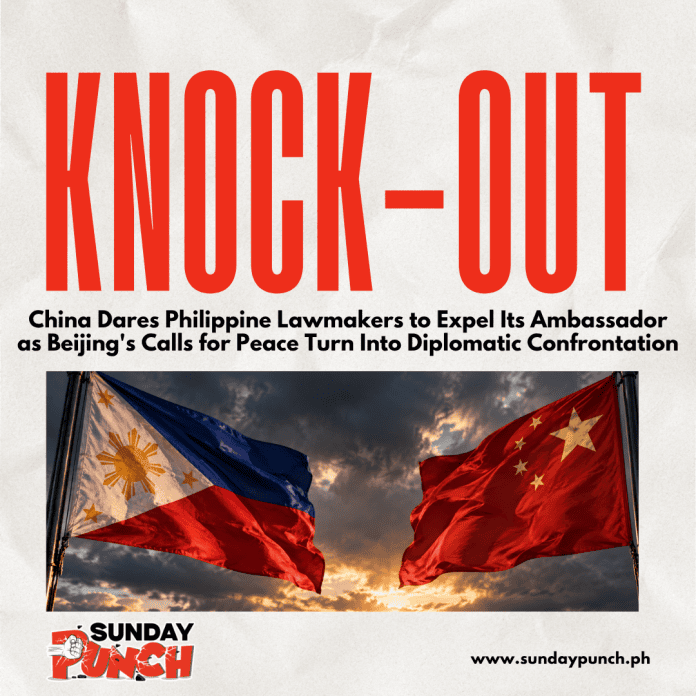
China says it wants peace with the Philippines, but its latest diplomatic exchanges appear to be doing remarkably little to preserve it. The Chinese Embassy in Manila has challenged Filipino lawmakers to declare Ambassador Jing Quan persona non grata, telling them to proceed or stop bluffing after several officials condemned his remarks about China’s military superiority. The confrontation raises an uncomfortable question about Beijing’s approach to diplomacy: if the objective is to improve relations with the Philippines, why has its embassy adopted language that appears more suited to provoking another argument than resolving an existing dispute? For a diplomatic mission tasked with maintaining communication between governments, the exchange has become an unusually public contest over who will back down first.
The controversy began after Jing responded to Defense Secretary Gilberto Teodoro Jr.’s criticism of China’s actions in the region. Speaking to reporters on October 15, the ambassador said China could easily prevail if it chose to use force, while maintaining that Beijing preferred peace. The Department of Foreign Affairs described the remarks as a thinly veiled threat, while President Ferdinand Marcos Jr. said they sounded threatening and were inappropriate for diplomatic communication. Senators Risa Hontiveros, Sherwin Gatchalian, Kiko Pangilinan, JV Ejercito, and other lawmakers subsequently demanded an apology, retraction, or stronger diplomatic action. Rather than lowering the temperature, the Chinese Embassy responded by challenging legislators to act on their proposals. Apparently, the promise of peaceful relations now comes with a public dare attached.
The embassy’s response extended beyond elected officials. In social media statements reported by the Philippine Daily Inquirer on October 18, it accused certain Filipino politicians and journalists of exaggerating tensions, misrepresenting facts, and promoting anti-China sentiment. However, the embassy did not identify specific inaccurate reports or provide supporting examples for those accusations. Maritime law expert Jay Batongbacal, director of the University of the Philippines Institute for Maritime Affairs and Law of the Sea, told the Inquirer that this confrontational approach was undermining China’s stated objective of improving bilateral relations. He argued that emphasizing superior military strength while appealing for dialogue weakened the credibility of Beijing’s diplomatic message. The contradiction is difficult to overlook: an ambassador may insist that his country has no intention of using force, but reminding a smaller neighbor how easily it could be defeated is hardly the most reassuring way to deliver that message.
Yet declaring Jing persona non grata is not necessarily a diplomatic victory for the Philippines. Stanford University maritime security analyst Ray Powell cautioned that such a move could invite retaliation from Beijing without resolving the underlying dispute. The Philippine government must therefore weigh the importance of defending its sovereignty against the potential consequences for bilateral relations, including trade and other areas of cooperation. The Marcos administration has emphasized continued diplomatic engagement while protecting Philippine interests, illustrating the difficult position Manila faces. Responding forcefully may demonstrate political resolve, but an escalating exchange of expulsions and retaliatory measures could reduce opportunities for communication precisely when tensions are already elevated. The challenge is determining which response protects Philippine interests rather than simply winning the latest round of public criticism.
Ultimately, the dispute over Jing’s diplomatic status risks becoming a distraction from the more consequential issues surrounding Philippine sovereignty and maritime security in the West Philippine Sea. The 2016 arbitral ruling rejected the legal basis of China’s expansive historic-rights claims within the limits examined by the tribunal, yet confrontations between Philippine and Chinese vessels have continued. China’s rejection of that ruling and its conduct in disputed waters remain central sources of disagreement, regardless of whether its ambassador stays or leaves. The embassy’s latest remarks may have intensified the diplomatic controversy, but the larger test is whether both governments can pursue meaningful engagement without treating military power as a substitute for persuasion. Diplomacy, after all, is supposed to manage disagreements between nations—not become another arena in which the stronger country reminds the smaller one of its strength.