
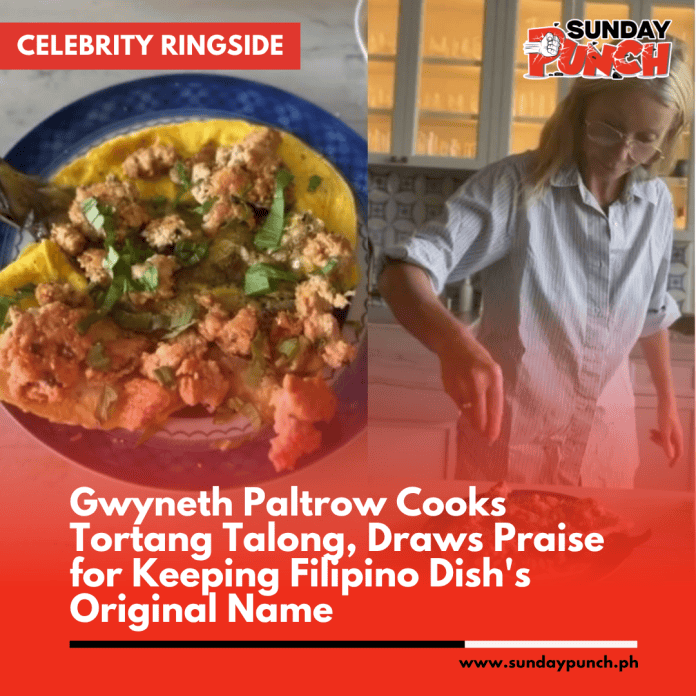
Filipino cuisine has once again found its way into a Hollywood kitchen, but this time, the most interesting ingredient may not be the food itself. Academy Award-winning actress Gwyneth Paltrow recently featured tortang talong in her Instagram cooking series, preparing the Filipino breakfast staple with garlicky turkey crumbles and homemade banana ketchup. While international celebrities experimenting with foreign cuisines is hardly unusual, Paltrow’s decision to identify the dish by its Filipino name has drawn particular attention. After all, a familiar local recipe does not suddenly become more sophisticated simply because someone gives it an English name and serves it on a different plate.
In an Instagram Reel shared on October 17, Paltrow demonstrated the preparation of tortang talong by grilling eggplant directly over a stove flame, peeling and flattening it, coating it in beaten eggs, and frying it. She then added her own variation using seasoned turkey crumbles and prepared banana ketchup from scratch. Describing the dish as a Filipino breakfast classic, the actress incorporated recognizable elements of its traditional preparation while introducing her personal interpretation. The video also follows her previous attempt at making Filipino pork tocino in April 2025, suggesting that her latest recipe is not her first encounter with Philippine breakfast food.
The video attracted reactions from Filipino personalities, including food content creator Erwan Heussaff, who thanked Paltrow for retaining the dish’s original name rather than simply calling it an eggplant omelette. His lighthearted comment points toward a larger issue in international food culture: how dishes are identified, presented, and credited when they cross borders. Descriptive English translations can help unfamiliar audiences understand foreign recipes, but they can also leave out the cultural identity attached to their original names. In this case, Paltrow managed to make a recognizable Filipino dish accessible to an international audience without stripping away the name Filipinos already know. Apparently, introducing international cuisine does not require a complete rebranding exercise.
The timing also reflects growing interest in Filipino home cooking beyond Philippine kitchens. Earlier this month, The New York Times published a feature on tortang talong, describing the humble combination of roasted eggplant and eggs as a versatile example of Filipino cooking. Unlike elaborate restaurant dishes or expensive culinary creations, tortang talong is commonly prepared using accessible ingredients and straightforward techniques. Its appeal challenges the assumption that a cuisine must be presented through luxury dining, intricate plating, or exotic ingredients to deserve international attention. Sometimes, a vegetable, an egg, and a frying pan already have a compelling cultural story to tell.
Ultimately, Paltrow’s cooking video is a modest but noteworthy example of Filipino culinary representation reaching an international audience. It does not establish a sudden global surge in demand for tortang talong, nor should one celebrity post be mistaken for proof of a broader culinary revolution. What it demonstrates is that traditional dishes can travel beyond their places of origin while retaining recognizable elements of their identity. Filipino cuisine does not need Hollywood’s permission to be valuable, but international exposure can introduce familiar recipes to people encountering them for the first time. And perhaps that is the real takeaway: tortang talong was already worth celebrating long before a Hollywood actress learned how to make it.
Images from gwynethpaltrow (IG)