
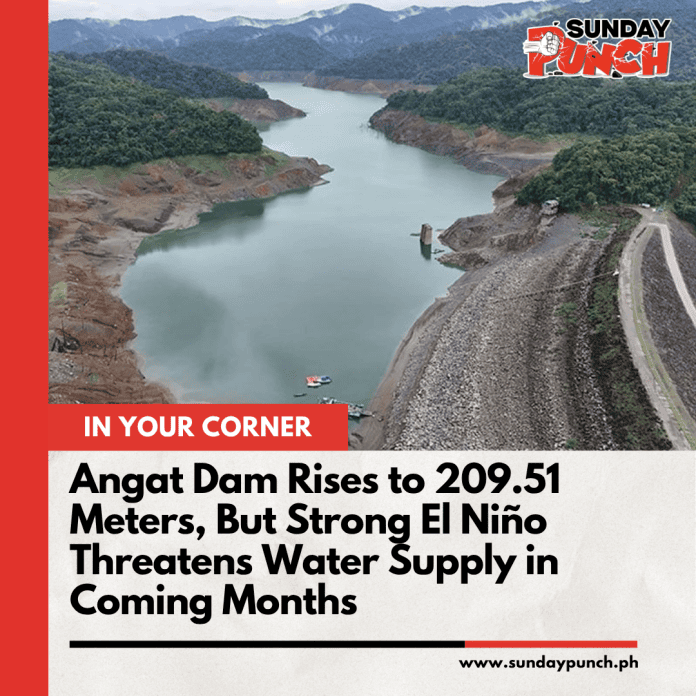
Angat Dam’s water level has recorded a slight increase despite persistent El Niño conditions, offering some reassurance for Metro Manila’s water supply while raising questions about how long the reservoir can maintain its reserves if rainfall declines in the coming months.
According to PAGASA’s October 18 monitoring report, the Bulacan reservoir reached 209.51 meters at 8 a.m. Sunday, an increase of four centimeters from Saturday’s 209.47 meters. The latest reading places Angat just 0.49 meters below its normal high water level of 210 meters, indicating that the reservoir remains close to its upper operating benchmark.
Angat plays a critical role in the country’s water infrastructure, supplying approximately 90% of the water requirements of the Metropolitan Waterworks and Sewerage System service area. Its importance makes changes in the reservoir’s water level particularly significant for millions of residents who depend on reliable water distribution across Metro Manila and surrounding communities.
Although the current reading remains relatively high, PAGASA has warned that strong to very strong El Niño conditions are affecting the tropical Pacific, with the phenomenon expected to persist through the first half of 2027. The weather bureau also indicated that El Niño could reach its peak before the end of 2026, increasing the risk of reduced rainfall, prolonged dry spells, and drought in vulnerable areas.
The reservoir’s operating range extends down to 180 meters, below which Angat enters its drought zone. While the latest reading remains well above that threshold, sustained dry conditions could gradually reduce available reserves if incoming rainfall fails to replenish water being released for household consumption, irrigation, and other needs.
PAGASA emphasized that El Niño does not mean rainfall will disappear entirely. Tropical cyclones, thunderstorms, and other weather disturbances can still bring substantial precipitation, although their timing and distribution may not be sufficient to offset prolonged periods of below-normal rainfall.
For households, the present situation does not indicate an immediate water shortage. However, it reinforces the importance of responsible consumption as the country approaches a potentially more challenging dry period. Simple measures such as repairing leaks, avoiding unnecessary water use, and conserving water during daily activities can help reduce pressure on supply systems.
Angat’s latest increase is encouraging, but a four-centimeter rise does not eliminate the longer-term risks associated with El Niño. Continued reservoir monitoring, effective water management, and early conservation measures will be essential to protecting supply as weather conditions evolve.
Image from STAR / Michael Varcas