
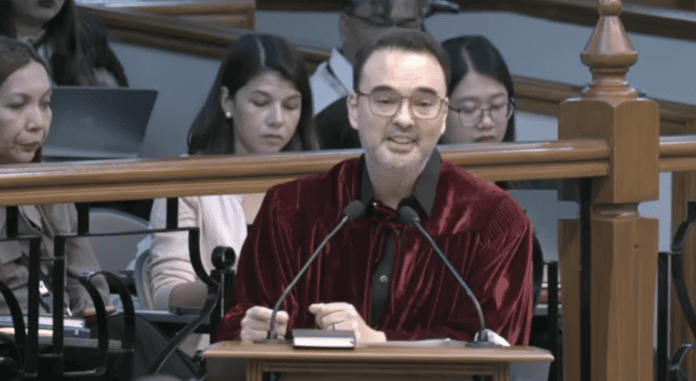
Senator-Judge Alan Peter Cayetano on Monday raised constitutional objections to the designation of a senator other than Senate President Sherwin Gatchalian as presiding officer in Vice President Sara Duterte’s impeachment trial.
Shortly after Gatchalian’s opening statement on the first day of trial on July 6, Cayetano raised a point of order challenging the Senate’s June 3 adoption of Senate Resolution No. 430, which amended the impeachment rules to allow another senator to be elected as presiding officer by a majority vote of members present.
He argued that the Constitution instead requires the Senate President to preside over all impeachment trials except when the President of the Philippines is on trial.
“It is very clear in the Constitution of the Philippines that the Presiding Officer is the Senate President. Section 3, Paragraph 6 of Article 11 of the 1987 Constitution, the Senate shall have the sole power to try and decide all cases of impeachment,” he said.
Cayetano, a senator-lawyer who has participated in previous impeachment proceedings, cited the deliberations of the 1986 Constitutional Commission, saying the framers deliberately clarified that distinction during the drafting of the Constitution.
He noted that then-Commissioner Hilario Davide Jr. expressly proposed that the Senate President would preside over all other impeachment trials, but later withdrew the amendment after the Constitutional Commission agreed that the Constitution already made that clear.
“It is but elementary, Mr. President, in statutory, especially construction of the Constitution, that the spirit as well as the letter is followed,” he said.
Cayetano argued that designating another senator to preside over the impeachment court would undermine the Senate’s institutional integrity and cast doubt on the legitimacy of the proceedings.
“We need to protect the legitimacy of these proceedings. Even if the substitute Presiding Officer acts fairly, a conviction or acquittal reached under a constitutionally defective process would invite judicial challenge and cast doubt on the validity of the entire trial,” he said.
He likewise argued that while the Senate has the constitutional authority to try impeachment cases, it must exercise that authority in accordance with the Constitution and its validly adopted impeachment rules.
“We cannot say we’re following the Constitution, then we will not follow the Constitution. If the Constitution and its framers prescribe who shall preside, who are we to change the Constitution here today?” he said.
Cayetano also pointed out that the adoption of Senate Resolution No. 48 remains one of the threshold issues raised in Cayetano v. Aquino, et al., which is pending before the Supreme Court.
He argued that even assuming the constitutional issue were set aside, efforts to amend the impeachment rules failed to comply with the Senate’s own procedures. Citing Rule LI, Section 136 of the Rules of the Senate, he said any amendment must be presented at least one day before it is considered.
He added that the impeachment court adopted its rules on May 18, meaning any amendment should first be taken up and approved by the impeachment court in accordance with its own rules.
“We did not debate that amendment to the rule. We cannot now just change the rules. We’re here for the trial. Are we here to change the rules?” he said.
Cayetano described both the issue of the presiding officer and the interpretation of the required two-thirds vote as “threshold issues” that must first be resolved before the impeachment trial proceeds.
“I want to avoid that this impeachment trial will be declared null and void. I want to avoid walkouts. I want to avoid any delays. The Senate President is more than capable [of presiding the trial],” he said.
Screenshot from the Senate of the PH FB