
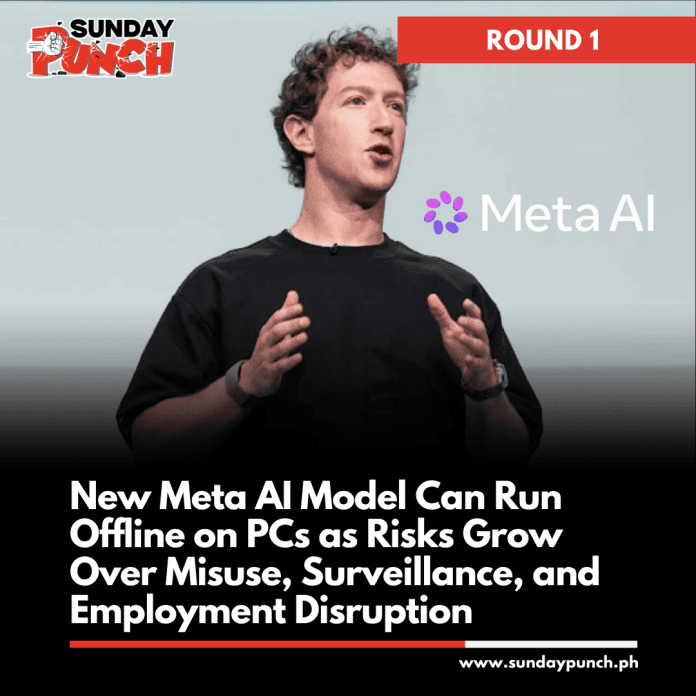
Meta is making a fresh push into advanced artificial intelligence, launching a new open-weight model while CEO Mark Zuckerberg warned that superintelligent AI could become dangerous if controlled only by a handful of companies, governments, or powerful institutions.
In a letter titled “The Future is for Everyone: The Path to a Positive AI Future,” Zuckerberg argued that AI should be built to expand what people can create, solve, and discover — not simply replace human work at scale. His broader pitch: superintelligence should not become a tool reserved for the few, because once too much technological power sits in too few hands, ordinary people, smaller businesses, and even governments may be forced to live under systems they did not shape.
The warning came as Meta introduced Muse Glimmer, an open-weight AI model with 30 billion learned parameters designed to run local AI agents on consumer devices. Unlike many cloud-based assistants, the model can operate on a Mac or PC with a single consumer GPU, allowing it to perform multi-step tasks offline while keeping user data on the device.
That design fits Meta’s argument for more open access to AI. Zuckerberg said broader distribution could help prevent one dominant system from controlling the direction of the technology. But the tradeoff is hard to ignore: making advanced AI easier to access can also widen the door to misuse, especially in cybersecurity, surveillance, employment disruption, and even biological or chemical threats.
Zuckerberg acknowledged those risks, but argued that the answer is not to slow down development too much. He warned that delaying American AI progress could weaken the United States against rivals such as China, creating economic and national security concerns. At the same time, he called for cooperation between governments and AI developers to address vulnerabilities in critical infrastructure.
For the public, the issue is bigger than one new model. AI is moving from online tools into devices, workplaces, and everyday decision-making. Meta is framing open AI as empowerment — but the same technology could also intensify job insecurity, privacy concerns, and the race among tech giants to control the next layer of digital life. The question now is whether “AI for everyone” will truly give people more power, or simply make a faster, more disruptive future harder to control.
Image from Meta