
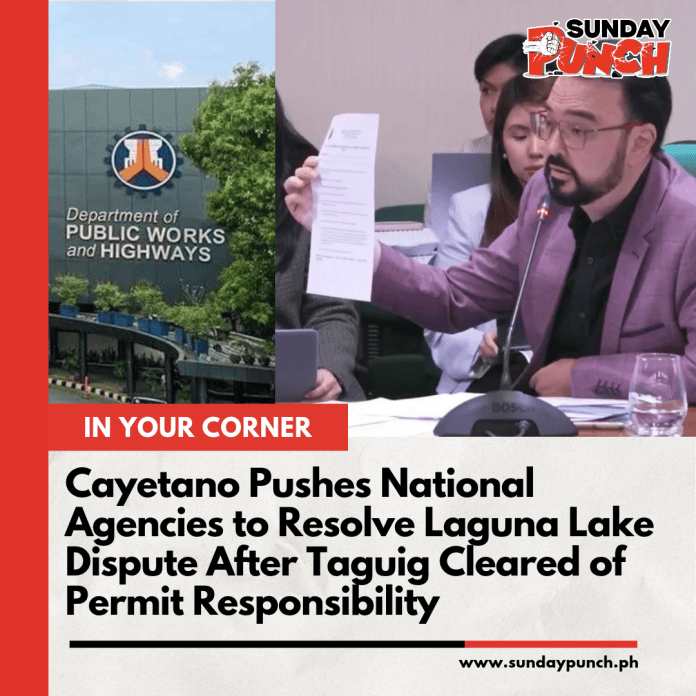
Taguig City should not be held responsible for permit issues involving national government projects along Laguna Lake, following a clarification by the Laguna Lake Development Authority (LLDA) that the obligation to secure the necessary permits rested with the Department of Public Works and Highways (DPWH).
The distinction emerged during the October 19 Senate hearing on the Department of Environment and Natural Resources’ proposed 2027 budget, where Senate Minority Leader Alan Peter Cayetano questioned LLDA officials about the agencies responsible for disputed lakeshore developments.
During the exchange, LLDA lawyer Atty. Marian Soriano identified the DPWH as the implementing agency behind most of the projects under discussion. When Cayetano asked which agency had failed to secure the required permits, Soriano again pointed to the DPWH, establishing a distinction between the national agency responsible for construction and the Taguig government responsible for managing some of the completed public spaces.
Cayetano argued that this distinction had been overlooked in public discussions surrounding the lakeshore controversy, leaving the city government facing criticism for obligations assigned to another government agency. He emphasized that Taguig’s operation of parks and recreational facilities does not automatically make the city responsible for permits associated with the original reclamation and construction works.
The hearing also exposed a separate disagreement over regulatory authority. LLDA officials asserted that their agency holds exclusive jurisdiction over development activities within Laguna Lake, challenging the role claimed by the Philippine Reclamation Authority (PRA) in requiring permits for certain projects.
For Cayetano, the conflicting positions highlighted the need for national agencies to establish a common understanding of their authority before assigning responsibility to local governments. He urged LLDA, DPWH, and PRA to resolve their differences and communicate the applicable requirements clearly, rather than allowing overlapping mandates to create uncertainty over existing infrastructure.
The senator also called for consistent enforcement across comparable developments, including flood-control structures, roads, public parks, and other lakeshore projects in areas such as Muntinlupa, Angono, and the Laguna Lake Road Network. He maintained that environmental regulations should be observed, but the same standards must apply regardless of a project’s location or implementing agency.
Cayetano raised a further concern involving developments constructed years before current permitting practices were imposed. Rather than immediately penalizing projects for requirements that may not have been enforced at the time of construction, he called on regulators to establish a reasonable process for reviewing and bringing existing facilities into compliance.
The clarification is particularly significant for Taguig, where lakeshore development includes public spaces and infrastructure intended to serve residents. Clearer agency responsibilities could help prevent regulatory disagreements from unnecessarily affecting the management and continued use of these facilities.
At the same time, LLDA’s statements do not remove the need to review whether individual projects meet environmental and legal requirements. Questions about permit compliance, the appropriate regulatory authority, and any potential violations remain matters for the responsible agencies to resolve.
The Senate hearing ultimately shifted attention from allegations directed at Taguig toward the responsibilities of the national agencies that planned, implemented, and regulated the projects. Cayetano’s position was that accountability must follow actual authority, with fair enforcement and clear rules taking priority over misplaced blame.