
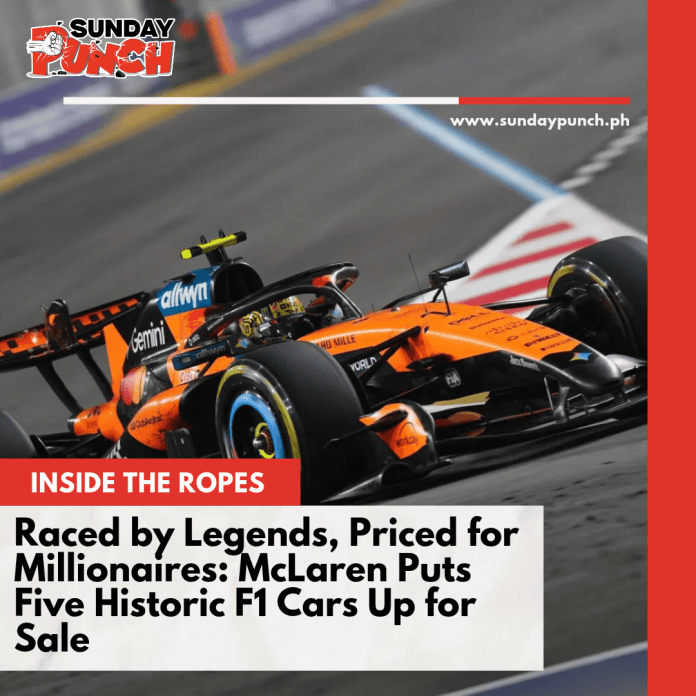
For most people, owning a piece of Formula One history means buying a miniature race car, a signed helmet, or perhaps a team jersey. For collectors with considerably deeper pockets, McLaren is offering something far more extraordinary: the actual machines that once competed on the world’s most prestigious racing circuits. McLaren Racing has announced the sale of five fully functioning Formula One cars spanning 32 years of motorsport history, including vehicles associated with Ayrton Senna, Lewis Hamilton, Jenson Button, Lando Norris, and even Hollywood actor Brad Pitt. The cars are expected to attract prices ranging from approximately £5 million to £10 million each, although official asking prices have not been disclosed. At that level, buyers are purchasing far more than horsepower and carbon fiber. They are paying for historical significance, racing pedigree, and the rare opportunity to own something that money alone could not ordinarily secure. Apparently, Formula One’s most exclusive souvenir shop comes with a multimillion-pound entrance fee.
The collection traces McLaren’s evolution from the early 1990s to modern hybrid-powered racing. Two Honda V12-powered MP4/6A cars from 1991, raced by Gerhard Berger and tested by three-time world champion Ayrton Senna, represent an era when McLaren dominated Formula One. The offering also includes a 2012 MP4/27A raced by Jenson Button and tested by seven-time champion Lewis Hamilton. Completing the collection are two cars driven in competition by Lando Norris: the 2021 MCL35M, which earned podium finishes at Imola, Monaco, and Monza, and the 2023 MCL37A, which secured consecutive runner-up finishes in Singapore and Japan. These are not replicas or decorative show cars created for wealthy enthusiasts. They are genuine racing machines that have remained in McLaren’s possession since their competitive careers, carrying histories that cannot simply be recreated on a production line.
Adding an unusual Hollywood connection to the collection is the 2023 McLaren, which Brad Pitt drove during a private session at the Circuit of the Americas in Austin, Texas, in connection with his involvement in F1 The Movie. The actor reportedly reached speeds of approximately 317 kilometers per hour, adding another layer of celebrity appeal to a car already associated with Norris and other professional drivers who tested it. The vehicle is being described as one of the most modern race-used Formula One cars offered for immediate private ownership. Its combination of recent racing history and Hollywood exposure illustrates an increasingly prominent feature of luxury collecting: an item’s value can extend beyond its technical specifications to the stories and personalities connected to it. In this case, a car that already had genuine Grand Prix credentials now comes with an additional distinction that no ordinary dealership could offer. Most used vehicles lose value with additional names on their driving history; this one may attract greater interest because of them.
McLaren Racing CEO Zak Brown explained that the decision to sell the cars reflects a desire to see them used rather than permanently stored away. The team has entrusted specialist dealer Tom Hartley Jr. with finding suitable buyers, with the cars to be prepared by McLaren before delivery. Brown argued that leaving historic racing machines sitting in storage would fail to honor the purpose for which they were built. The approach presents an interesting contrast in the world of luxury collectibles, where rarity often encourages owners to preserve valuable objects rather than risk damaging them through use. McLaren is effectively asking collectors to do both: protect important pieces of motorsport history while allowing them to perform as functioning race cars. Of course, maintaining a genuine Formula One machine requires specialized technical support and resources far beyond those of an ordinary sports car. The purchase price may secure the keys, but keeping a championship-era racing machine operational is an entirely different financial commitment.
Ultimately, the sale reflects how Formula One has evolved beyond competitive motorsport into a global market for heritage, entertainment, and exclusive ownership. Historic race cars can serve as investments, engineering artifacts, and physical reminders of unforgettable sporting achievements, although their future resale values are never guaranteed. For McLaren, the offering provides an opportunity to place part of its history in private hands while maintaining the legacy of machines that helped define different generations of racing. For collectors, it represents the rare chance to own vehicles connected directly to some of Formula One’s most recognizable figures. And for ordinary fans, the announcement offers a fascinating glimpse into the extraordinary economics of the sport. Millions can buy a racing car once driven by a world champion, but they cannot buy the victories, talent, or moments that made it legendary. The machinery is now available for purchase. The history behind it remains priceless.