
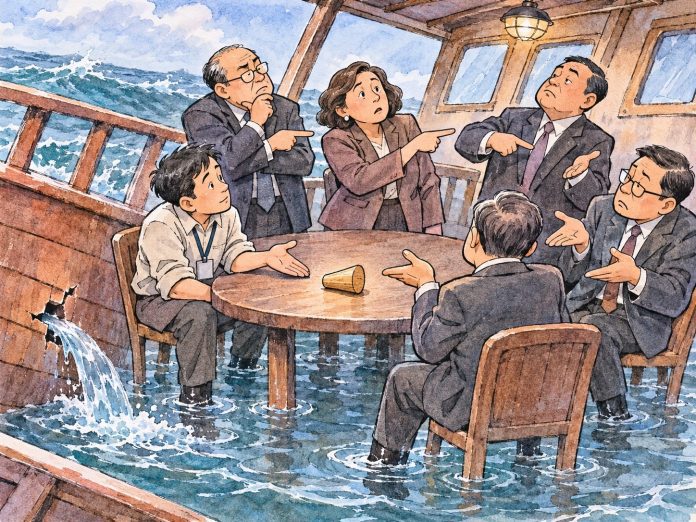
On Monday, in the thick of the Senate budget debates, Senate Minority Leader Alan Peter Cayetano asked what sounded like a trick question. If every Filipino’s share of the national debt comes to about ₱170,000, where does he go to pay his?
At the time, there was no established mechanism for someone who wanted to help pay it down.
By Tuesday, the Palace had replied. “Pasimulan na po niya,” said the Palace press officer. Let him start it.
Mauna ka muna.
The sequence is telling: he asked where to pay, was told there was no mechanism, and was then challenged to go first.
I am not writing to defend the proposal. There is plenty to say against it. If a million Filipinos each paid the full ₱170,000, they would retire less than one percent of what we owe. People who doubt where their taxes go will not line up to hand over more, a point the senator made himself before anyone else could. Say all of that. Say it loudly. That is a debate.
But the government’s response shifted the focus from the idea to its author. The finance committee chair, after consulting the economic team, said the best contribution is to pay the correct taxes. That is true, but it did not answer someone who said he already pays his taxes and wanted to do more. The Palace said you first, and added that he could write the law himself. Of the three, only the Executive Secretary treated the question as a question. The BIR or the Treasury could take the money, he said, “baka may resibo,” and the government would listen to proposals on how to do it properly.
One in three. And notice where the other two pointed: back at the man who asked.
We have watched this before. In October last year the same senator suggested that every elected national official resign, himself included, and sit out the next election so the country could start clean. The replies came quickly. Resign first, then. The Palace called it wishful thinking. Before that, in the worst of the pandemic, he wanted ₱10,000 for every Filipino family, and filed the bill in the House and again in the Senate.
You do not have to like any of these ideas. I am not sure I like all of them. But look at the other side of the microphone. Each time, nobody answered the idea. They answered the man.
Meanwhile, the thing he was pointing at has not moved. I have yet to hear one official argue that ₱19.66 trillion is a comfortable number, or that an economy growing at its slowest since the pandemic, with prices still climbing, is doing fine. Whatever we have been doing has not been enough. So what exactly is wrong in offering an unusual solution to a seemingly impossible problem? Surely a crisis this far out of the ordinary can survive an out-of-this-world suggestion or two. Most of them will fail. You test ten to find one.
Some of us are old enough to remember when it went the other way. As children we were told that people were going to the moon, which is about as outrageous as an idea gets, and then we watched them go. The dream did not make the work unnecessary; it gave the work somewhere to go.
An unusual idea does not deserve automatic approval. It does deserve a hearing. Ask what it would take to make it work, then examine the cost and the risks. If it fails those questions, explain why. That is how imagination becomes a serious proposal.
Somewhere we lost that sense of possibility. The reflex now is to find the reason the person had no business speaking: his record, his motive, his nerve. We called it utak talangka when the neighbors did it. It does not improve when it comes with a podium.
The senator will be fine. He has a microphone and a thick skin. But the lesson can reach people we never hear from: the budget analyst with an odd fix for a bad process, the municipal engineer who thinks there is a cheaper way, the young staffer two years into government who still raises her hand. They are watching what happens to people who propose things. “Mauna ka muna” teaches them that the safe move is to keep the idea in the drawer.
It teaches the public something as well. It can reinforce a suspicion some Filipinos already voice: that their officials would rather win the exchange than fix the problem. Every dare offered in place of an answer tells them they were right.
None of this requires agreeing with anyone. Take the idea apart. Put a number on it. Say what would have to be true for it to work, or say plainly why it never will. That is being part of the solution, even when the answer is no.
How we respond says a great deal about who we are. A proposal may be wrong; its author may be someone we oppose. Still, we should test it on its merits. Otherwise, the problem remains—and fewer people will offer solutions.