
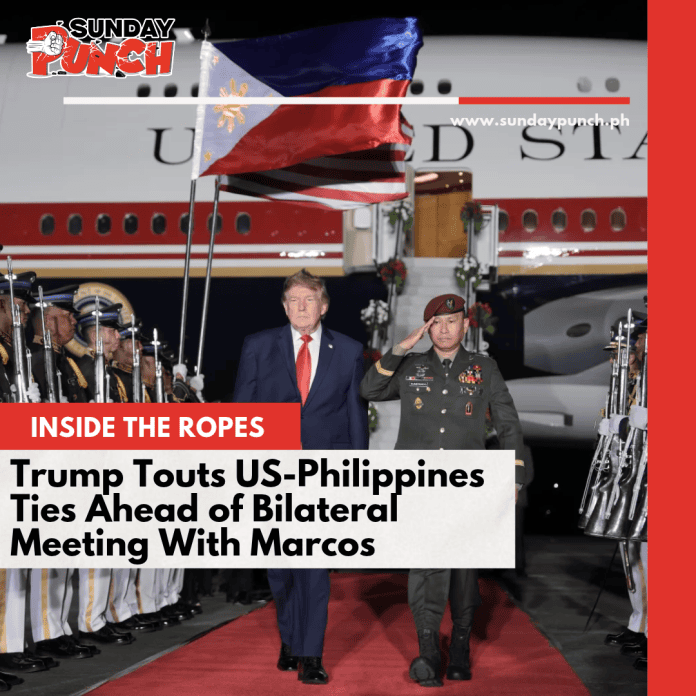
US President Donald Trump wasted little time advancing Washington’s economic and security agenda after arriving in Manila on November 17, 2026, for the 49th ASEAN Summit. Within hours of landing, Trump met with Indo-Pacific leaders, discussed critical minerals and regional defense cooperation, and signed a preliminary trade statement with Thailand. His visit placed the Philippines at the center of high-level diplomatic discussions involving the United States, Southeast Asia, and major regional powers.
Trump joined Australian Prime Minister Anthony Albanese, Indian Prime Minister Narendra Modi, and Japanese Prime Minister Sanae Takaichi for a meeting of the Quadrilateral Security Dialogue, or Quad. The four leaders reaffirmed their commitment to a free and open Indo-Pacific while announcing plans to strengthen maritime security, artificial intelligence cooperation, and critical mineral supply chains. Trump also predicted that American rare-earth production could catch up with China’s within 10 months, although the claim remains a projection rather than an established industry forecast.
On the economic front, Trump and Thai Prime Minister Anutin Charnvirakul signed a joint statement outlining progress toward a reciprocal trade agreement, with a final deal still under negotiation. The proposed arrangement includes expanded access for American products and additional Thai purchases of US agricultural goods. Addressing ASEAN leaders later that evening, Trump also reaffirmed Washington’s commitment to Southeast Asia, emphasizing opportunities in energy, technology, defense, and mineral resources while highlighting the United States’ close alliance with the Philippines.
Trump is also scheduled to meet President Ferdinand Marcos Jr. on November 18 before traveling to China for the Asia-Pacific Economic Cooperation summit. Their bilateral discussions are expected to cover defense cooperation, regional security, and economic relations, including Philippine concerns over US tariffs on exports. Meanwhile, Trump’s Manila visit drew protests over American foreign policy and the proposed Pax Silica initiative. With competing economic and security interests shaping the Indo-Pacific, the meetings highlighted both the opportunities and challenges facing the Philippines as it balances its alliance with Washington and relations with China.
Image from AP Photo/Mark Schiefelbein