
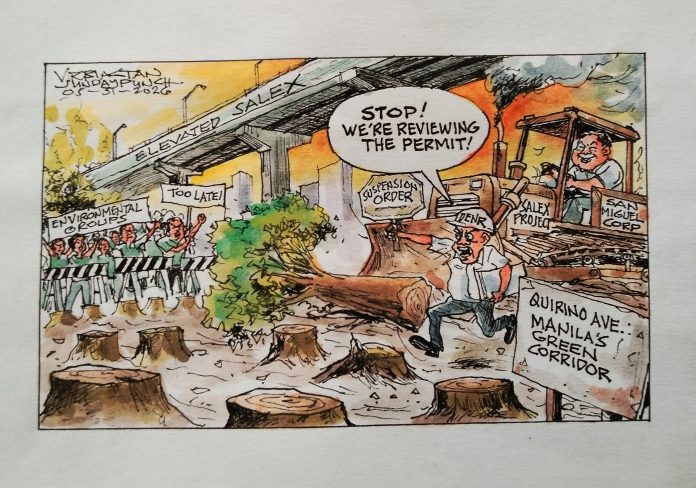
THE suspension of tree-cutting operations along Quirino Avenue in Manila for the construction of the more than 42-kilometer elevated Southern Access Link Expressway (SALEX) came a little too late.
By the time the Department of Environment and Natural Resources (DENR) and project proponent San Miguel Corporation agreed to halt the cutting, more than 200 decades-old trees had already fallen — silent victims of a development mindset that often places concrete above environmental preservation.
Ironically, it was the DENR itself that issued the permit allowing the tree-cutting operations in the first place. Now, amid mounting public outrage and organized protest actions, the agency says it is “reviewing” the matter and considering the earth-balling and replanting of remaining mature trees to other available spaces.
Environmental groups, however, are not satisfied with a mere suspension. Kalikasan People’s Network for the Environment is pushing for a permanent stop to the tree-cutting and is even studying possible legal action against those responsible for what it describes as environmental destruction.
Their anger is understandable.
For residents and environmental advocates, the trees along Quirino Avenue represented one of Manila’s few remaining green corridors — a natural shield against heat, pollution, and flooding in an increasingly congested and overheated metropolis. Losing them in the name of modernization only reinforces fears that urban development in the country continues to come at the expense of ecological balance.
Development and infrastructure are necessary. No one disputes the need for better roads and improved mobility in Metro Manila. But progress should never mean indiscriminate destruction of the environment, especially when alternatives and mitigation measures can be explored before irreversible damage is done.
This controversy should serve as a wake-up call for government agencies and private contractors alike: environmental protection cannot remain a mere afterthought in infrastructure planning. Once century-old trees are cut down, no amount of public relations damage control can immediately restore what has been lost.