
By: Raymond Dimayuga
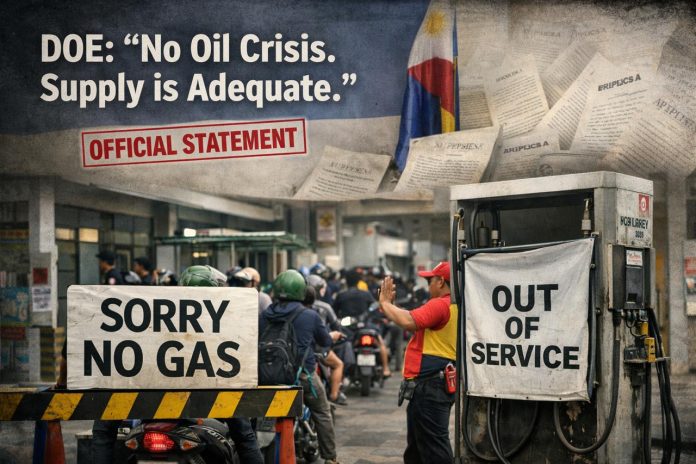
According to Department of Energy Secretary Sharon Garin, there is no oil crisis in the Philippines. Supply, she assures, remains adequate. The system is stable. The situation, under control.
Tell that to the driver who lined up for an hour only to be told, “Wala nang gasolina.”
Tell that to the tricycle operator who had to go home early because the nearest station suddenly shut down.
Tell that to commuters watching fares creep up like a quiet thief in the night.
Because somewhere between the press release and the pavement, reality is breaking down.
This is the peculiar theater of governance: where data says one thing, and lived experience says another. On paper, there may be no “crisis.” Tankers may still be arriving. Inventories may still be logged. But on the ground, supply that exists but cannot be accessed might as well not exist at all.
What people are experiencing is not a theoretical shortage. It is a functional one.
And that distinction matters.
A government can insist that supply is “adequate,” but adequacy is not measured in spreadsheets alone. It is measured in whether a jeepney driver can complete a day’s boundary, whether a delivery rider can take one more booking, whether a family budget can survive another week of rising costs. When gas stations start closing without clear explanation, when pumps suddenly run dry, when uncertainty becomes routine, people do not consult official statements. They adjust, they worry, they absorb the cost.
And they remember.
The danger here is not just the price of fuel. It is the erosion of trust. Because when official assurances consistently fail to match lived reality, credibility evaporates faster than gasoline on hot concrete.
So which is it?
Is there truly no crisis, and what we are seeing are isolated disruptions poorly communicated and poorly managed? Or is the definition of “crisis” being stretched so thin that it no longer reflects the public’s experience?
Because for ordinary Filipinos, a crisis does not begin when supply hits zero. It begins when stability disappears. When predictability is gone. When everyday life becomes a gamble.
This is not merely a question of semantics. It is a question of alignment. Between government and governed. Between report and reality.
If there is no oil crisis, then explain the empty pumps.
If supply is adequate, then explain the sudden closures.
If everything is under control, then why does it feel like it isn’t?
Governance is not just about being correct. It is about being credible. And credibility, once lost, is far more difficult to replenish than fuel.
Until then, people will continue to trust what they see, what they feel, and what they endure over what they are told.
And right now, what they are experiencing does not feel like “no crisis” at all.
—
Eat the Worm is a weekly column that dives headfirst into unconventional ideas, uncomfortable truths, and the gritty realities we often shy away from. Much like the brave tradition of “eating the worm” in a tequila bottle, this column challenges readers to confront the hard stuff with courage and curiosity. This is a fearless exploration of life’s rawest and most compelling topics.