
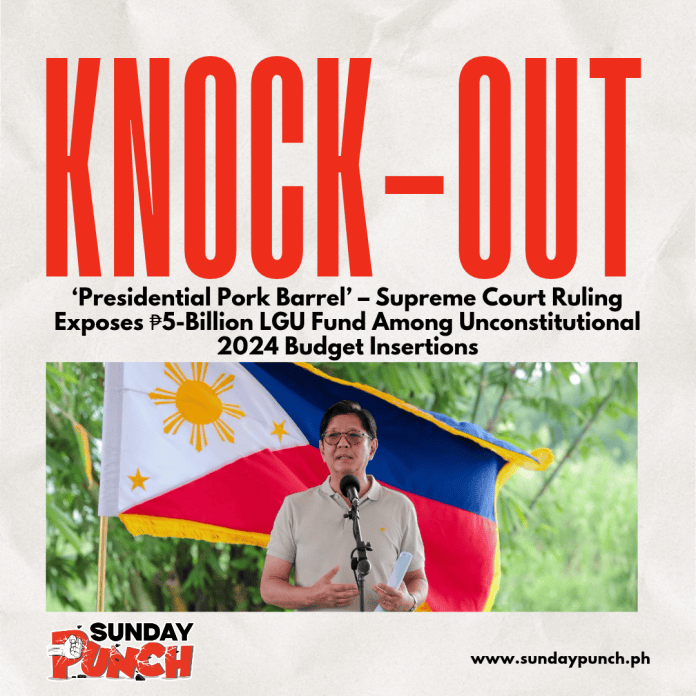
The Supreme Court has declared unconstitutional the ₱449.5-billion increase in unprogrammed appropriations under the 2024 national budget, which included a ₱5-billion Local Government Support Fund (LGSF) inserted during congressional budget deliberations. The fund was among 43 additional budget items worth approximately ₱303.1 billion introduced by the bicameral conference committee. The High Court ruled that Congress exceeded constitutional limits by increasing total appropriations beyond the amount recommended by the President, raising serious concerns over how billions in public funds were authorized outside the government’s original spending proposal.
In his separate concurring opinion, Associate Justice Alfredo Benjamin Caguioa singled out the ₱5-billion LGSF, describing it as a “Presidential Pork Barrel” because of the broad discretion it granted the executive branch over the allocation of funds. Caguioa argued that the 2024 budget failed to establish meaningful restrictions on how the money could be distributed among local government units, drawing comparisons with the controversial Priority Development Assistance Fund previously struck down by the Supreme Court. His criticism focused on the absence of clearly defined spending limitations, which could allow the executive branch to determine funding recipients and projects after Congress had already approved the budget.
The ruling places renewed scrutiny on the budget process under the Marcos administration, particularly as lawmakers examine the proposed ₱58.53-billion LGSF allocation for 2027. Malacañang has defended the program as a funding source for rice assistance, farm-to-market roads, water systems, healthcare facilities, and evacuation centers. However, the Court’s findings reinforce the need for transparent appropriations and enforceable limits on government spending. The decision does not establish that the ₱5 billion was stolen or misused, nor does it automatically invalidate every completed project funded through the 2024 budget. Nevertheless, the ruling raises significant accountability questions over how the fund was approved, who exercised control over its distribution, and whether similar allocations in future budgets comply with constitutional safeguards.
Image from Bongbong Marcos FB