
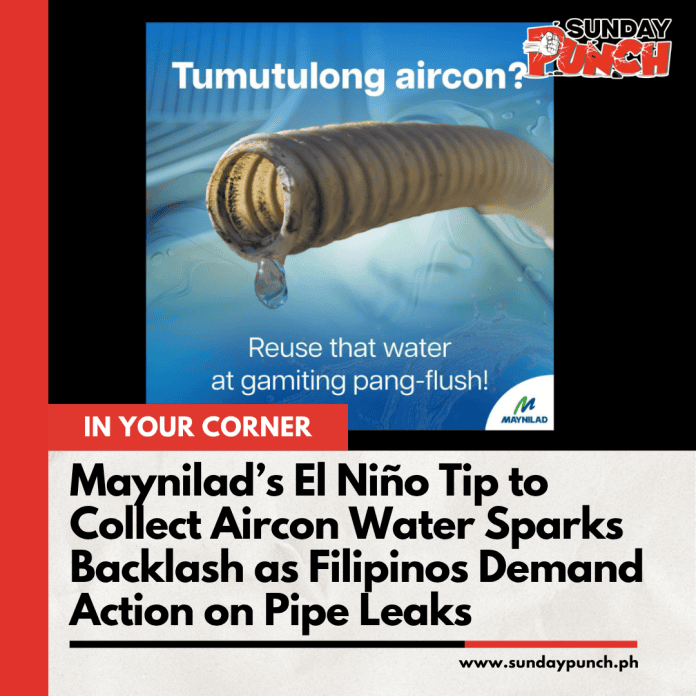
Filipinos are being encouraged to collect water from their air conditioners to prepare for possible El Niño-related shortages, but some consumers have a question for the company offering the advice: what about the water escaping from its own pipes? Maynilad Water Services recently recommended collecting air-conditioning condensation for toilet flushing, prompting an online discussion that quickly shifted from household conservation to infrastructure accountability. The suggestion may be practical, but its reception exposed a deeper frustration: why are consumers being reminded to save water by the container while losses across the distribution system remain a concern?
According to a report by Interaksyon, Maynilad advised households to collect water dripping from air-conditioning units and reuse it for flushing toilets, while warning against storing it for extended periods because of possible bacterial growth. The recommendation comes as the Philippines prepares for potential water supply pressures associated with El Niño. However, several Facebook commenters responded by raising concerns about reported pipe leaks, unfinished roadworks, and the concessionaire’s responsibility to minimize wasted water. Some questioned the logic of promoting household conservation while alleging that damaged pipes in their communities remained unrepaired. The individual complaints have not been independently verified, but they point toward a legitimate issue: conservation is not exclusively the responsibility of the person receiving the water bill.
The criticism becomes more significant when placed alongside Maynilad’s own performance figures. In a September 28 statement, the concessionaire reported that its average non-revenue water level improved from 36.7% in the first half of 2025 to 31.5% during the same period in 2026. Non-revenue water includes physical losses such as leaks, as well as water that is consumed but not billed or properly accounted for, meaning the percentage cannot be treated entirely as leakage. Maynilad also reported recovering more than 150 million liters per day compared with June 2025 through repairs and network rehabilitation. The improvements are substantial, but the figures also illustrate the enormous scale of water management: while households are being asked to collect condensation one container at a time, the utility is measuring its recovery efforts in millions of liters.
To its credit, Maynilad has reported significant investments and measurable progress in reducing system losses. The company said it allocated ₱7.7 billion in 2026 toward non-revenue water management, including pipe replacements, leak detection, and network improvements, with a target of reducing its NRW level to 25% by 2027. These measures demonstrate that the concessionaire is addressing the problem, even as consumer concerns highlight the continuing importance of timely repairs and reliable service. Household conservation and infrastructure improvement are not competing solutions; both are necessary. Still, there is something distinctly ironic about a water utility asking the public to preserve every drop while its own figures show how much work remains to improve distribution efficiency. Apparently, water conservation is a shared responsibility—but the size of the responsibility depends considerably on who controls the pipes.
Ultimately, the controversy is less about whether aircon water can be reused and more about who should carry the burden of preparing for climate-related shortages. Maynilad’s recommendation is a reasonable household measure, particularly when water availability could become more uncertain. But the public response demonstrates why conservation campaigns need to be accompanied by transparent reporting, responsive maintenance, and continued infrastructure investment. Filipinos can collect condensation, shorten showers, and reuse water wherever practical. What they cannot do is personally repair an aging distribution network. As El Niño places water security back in the spotlight, the challenge is ensuring that saving water is not merely something consumers are told to practice, but something their service providers can continue to demonstrate at scale.
Image from Maynilad Water Services, Inc. (FB)