
The Philippine economy may be measured in billions of pesos, growth percentages, and financial forecasts, but millions of Filipino households appear to be measuring their circumstances by a considerably simpler standard: whether their income is enough to get by. According to the latest Social Weather Stations (SWS) survey, 55% of Filipino families considered themselves poor in September 2026, the highest self-rated poverty level recorded so far this year. That translates to an estimated 16.8 million families, up from 13.6 million in June. While economic indicators can describe the country’s performance from a national perspective, the figures raise an uncomfortable question about how much of that progress is being felt inside Filipino homes.
Conducted from September 21 to 27 among 1,500 adults nationwide, the SWS survey recorded a six-percentage-point increase in self-rated poverty from 49% in June. Perhaps more revealing, however, was the decline in families identifying as neither poor nor not poor, falling from 14% to just 9%. Meanwhile, the proportion identifying as not poor remained nearly unchanged at 36%. The figures suggest that more families are moving away from the uncertain middle and identifying themselves as poor, rather than a corresponding rise in households feeling financially secure. Apparently, even the middle ground is becoming increasingly difficult to occupy.
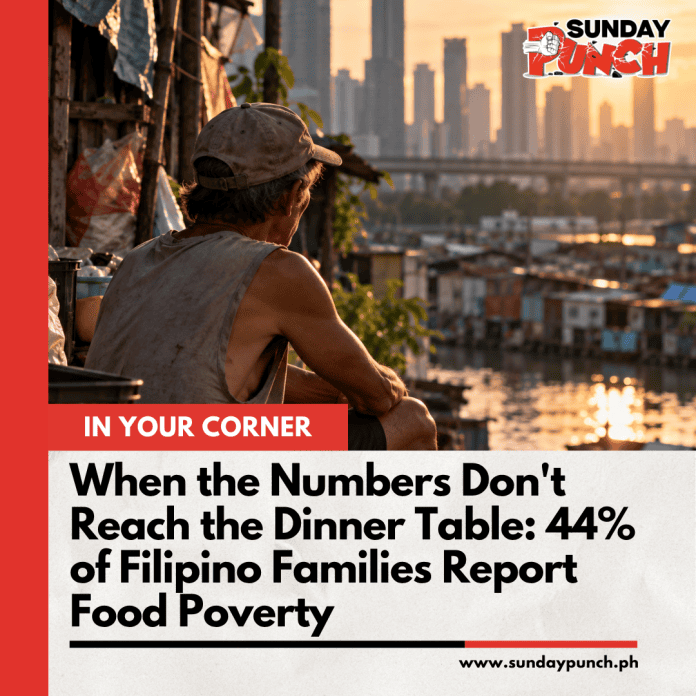
The picture becomes more concerning when food enters the equation. SWS reported that 44% of Filipino families considered themselves food-poor, up eight percentage points from 36% in June. Based on the polling firm’s population estimates, approximately 13.3 million families now identify as poor according to the food they eat, compared with 10.2 million three months earlier. This measure reflects households’ own assessments rather than an official calculation of food affordability, but its implications remain significant. When families begin questioning the adequacy of what reaches their tables, discussions about economic progress become considerably harder to separate from everyday survival. A growth forecast, after all, is difficult to serve for dinner.
The increase was recorded across all major geographic areas, with self-rated poverty reaching 64% in Mindanao, 63% in the Visayas, 51% in Luzon outside Metro Manila, and 44% in the National Capital Region. Food poverty followed a similarly troubling pattern, affecting 52% of families in Mindanao and 51% in the Visayas. These findings do not establish that every household experienced declining income, nor do they identify a single cause behind the worsening perceptions. They do, however, demonstrate that the reported struggle extends well beyond one region. For policymakers, the challenge is not simply presenting favorable national statistics, but understanding why so many households continue to perceive themselves as financially vulnerable.
Importantly, SWS measures self-perceived poverty, which differs from the Philippine Statistics Authority’s official poverty estimates based on income thresholds. Its findings should therefore not be interpreted as proof that the country’s official poverty incidence has reached 55%. Nevertheless, the survey provides a perspective that conventional economic measurements cannot fully capture: how families themselves evaluate their living conditions. The growing number identifying as poor or food-poor raises questions about the reach and effectiveness of economic improvements, social protection, and household purchasing power. Ultimately, progress cannot be judged by statistics alone when the people those statistics are meant to represent are reporting a different experience. The economy may have its own definition of improvement, but Filipino families still have to make the household budget work.