
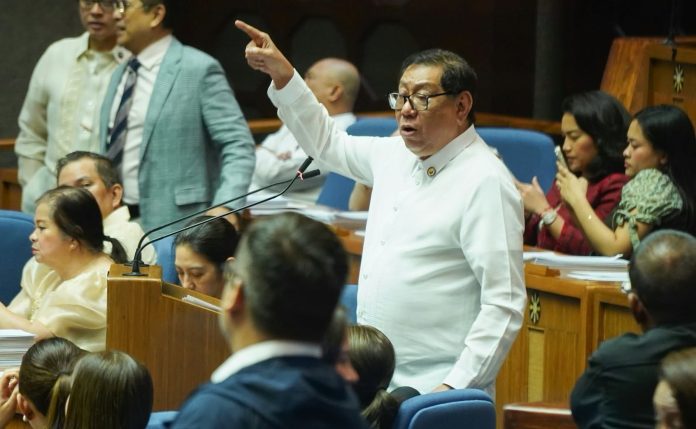
Caloocan City Second District Representative Edgar “Egay” Erice called on President Ferdinand Marcos Jr. and the Department of Budget and Management to halt all remaining unprogrammed appropriations releases inconsistent with the Supreme Court’s recent budget ruling and applicable enforceable orders.
Erice also urged the suspension of remaining undisbursed Local Government Support Fund allocations, including Financial Assistance to LGUs, pending a public demonstration that their purposes, allocation standards and release mechanisms satisfy constitutional requirements.
“The government has been put on notice. Public money cannot continue to flow through mechanisms that disregard the constitutional limits identified by the Supreme Court,” Erice said.
“The right to seek reconsideration must be respected. But an announcement that government will seek reconsideration is not, by itself, authority to disregard an enforceable prohibition.”
Erice warned that if the government announces it will proceed with noncompliant releases, he will file the appropriate petition seeking a temporary restraining order or other injunctive relief.
“Hindi natin kailangang hintaying maubos ang pera bago kumilos. Kapag malinaw na ipagpapatuloy ang releases na labag sa umiiral na pagbabawal, hihiling tayo sa Korte ng kaukulang restraining order upang maprotektahan ang kaban ng bayan,” he said.
The Court’s ruling addressed the ₱449.5-billion congressional increase in 2024 unprogrammed appropriations, increases involving special accounts in the 2025 budget, and specified release provisions in the 2026 budget. It also rejected the SAGIP lump-sum mechanism under the 2024 and 2025 budgets.
Erice stressed that recognizing unprogrammed appropriations as permissible in principle does not authorize unrestricted spending. They must remain limited standby authorizations consistent with constitutional safeguards and the national fiscal program.
“Hindi sapat na sabihing pinayagan ang UA. Kailangang legal ang appropriation, malinaw ang layunin at pamantayan, at nasunod ang funding conditions. Hindi puwedeng blank check ang pera ng bayan,” he said.
On LGSF and FALGU, Erice clarified that his suspension demand seeks to prevent further questionable spending while their compliance is examined; it does not imply that the Court expressly invalidated every LGSF allocation.
“If the law leaves the Executive to decide the fundamental spending purposes and allocation policy only after enactment, that arrangement must be scrutinized. Broad administrative guidelines cannot substitute for essential decisions Congress itself should make,” he said.
Erice likewise challenged the Executive and congressional leadership to demonstrate good faith by publishing a complete, project-level accounting of reductions and reallocations made during preparation and enactment of the 2024 and 2025 budgets.
The disclosure should identify each affected program, activity or project; its original and final allocation; the amount removed; where the corresponding funds were redirected; and the records identifying who proposed and approved the changes.
“Show us exactly which PAPs were reduced, by how much, and where the money went. Publish the amendment records, reconciliation worksheets and supporting documents. The public deserves a traceable account of these decisions,” Erice said.
He warned that deliberate concealment, false explanations or knowing circumvention of enforceable restrictions could support findings of bad faith and possible civil, criminal or administrative liability in the proper proceedings.
“A reduction or realignment alone does not establish a crime. But officials cannot invoke good faith while deliberately concealing the records needed to examine their actions,” he said.
Erice also cautioned against treating the operative fact doctrine as continuing permission to spend. While the Court applied the doctrine to the 2024 and 2025 budgets, it did not automatically shield their authors, proponents and implementors from liability.
“Protection for past acts undertaken in good faith is not advance protection for knowingly unlawful future releases. Officials cannot assume that the operative fact doctrine will excuse spending undertaken in deliberate disregard of an enforceable Court order,” he said.
Responding to suggestions of judicial overreach, Erice maintained that determining constitutional limits in an actual budget controversy falls within the Court’s judicial function.
“Congress appropriates, the Executive implements, and the Supreme Court determines constitutionality. The political branches may ask the Court to reconsider, but they cannot substitute their own judgment for its final ruling,” he said.
“If the government wants to prove it can self-correct, it should begin with full disclosure, lawful releases and a constitutionally compliant budget.”
Image from Egay Erice (FB)