
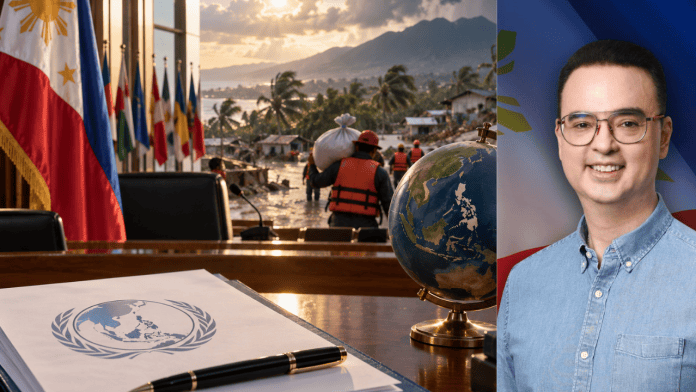
Senate Minority Leader Alan Peter Cayetano on Wednesday backed an agreement formalizing the Philippines’ hosting of the governing body of a global fund designed to help climate-vulnerable countries recover from typhoons, floods, and other impacts of climate change.
The Senate Committee Report 97, which Cayetano signed along with other senators on September 9, allows the country to host the Board of the Fund for Responding to Loss and Damage, under a measure principally sponsored by Senate Majority Leader Juan Miguel Zubiri.
The Philippines was selected in 2024 to host the Fund’s Board and Secretariat over seven other countries, a role that takes on greater significance as the country ranks first in the WorldRiskIndex for the fourth consecutive year and faces a moderate-to-strong El Niño that could intensify before the end of 2026.
Created to assist developing countries particularly vulnerable to climate change, the Fund may support immediate humanitarian needs as well as recovery, reconstruction, rehabilitation, displacement, relocation, and other losses caused by extreme weather and slow-onset climate impacts.
The agreement complements Cayetano’s long-standing push for stronger disaster preparedness and rehabilitation as extreme weather places greater pressure on Filipino communities.
The senator is consistent in pushing Senate Bill No. 105, or the proposed Emergency Response Department (ERD) Act, which seeks to establish a dedicated department responsible for year-round disaster preparedness, response, recovery, and rehabilitation.
“We have to seriously address this ‘new normal’ of extreme weather in the country,” he said.
“Magaling na tayo sa relief programs, pero sa rehabilitation at disaster management, mahina pa,” he added.
As of March 2026, the Loss and Damage Fund had received $822 million in pledges from 27 parties, with around $591.71 million already transferred.
Hosting the Fund’s Board is also expected to strengthen the Philippines’ participation in international cooperation on climate finance, adaptation, and resilience while building local capacity and bringing the Fund’s operations closer to countries most exposed to climate impacts.
Cayetano has maintained that while disasters cannot always be prevented, government can limit their impact through sustained preparation and investment in resilient communities.
“We may not be able to stop disasters but we can empower ourselves with knowledge, training, education, equipment, tools, and the right infrastructure to cope with disasters so many lives would not be lost and there would be less devastation,” he said.