
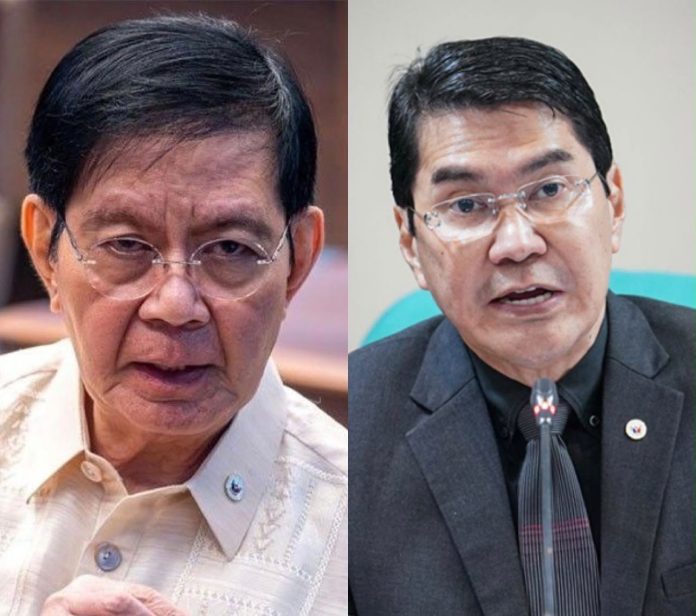
Senator Panfilo Lacson, who in May publicly calculated how the arrest of two colleagues would hand his bloc control of the Senate, on Saturday questioned the motives of three senators who voted to revive a legal challenge to Senator Erwin Tulfo’s seat.
“Justice and fairness went out of the window when three minority senator-members voted in favor of an out-of-time motion for reconsideration filed by a petitioner without legal standing,” Lacson said on X. “Their motive may be deeper than personal issues against Sen Tulfo.”
Lacson did not name the three. The Senate Electoral Tribunal’s minority members are Senators Pia Cayetano, Robin Padilla and Camille Villar; Senators Francis Pangilinan, Bam Aquino and Lito Lapid sit for the majority, alongside three Supreme Court justices.
The tribunal on Friday voted 6-3 to deny a motion for reconsideration filed by disbarred lawyer Berteni Causing, whose original quo warranto petition was dismissed on March 2 as insufficient in form. The motion was filed in April, past the deadline. The denial was without prejudice to a new petition; the three dissenting votes did not amount to a ruling unseating Tulfo.
In a follow-up post, Lacson credited the justices and the three majority senators who, he said, “undoubtedly knew the obvious procedural flaw.” The senators’ votes fell along bloc lines. Lacson attributed legal clarity to one side and hidden motives to the other, without saying what those motives were.
**The May arithmetic**
Five months earlier, Lacson applied a different lens to legal proceedings against colleagues on the other side.
On May 28, with the Senate deadlocked under then-Senate President Alan Peter Cayetano, Lacson walked reporters through the numbers. If Senator Jinggoy Estrada were detained, the floor would split 11-11 and the Cayetano majority could no longer muster 13 for a quorum. He said Senator Joel Villanueva’s case was “ripe” and could be filed within two weeks. With both out, his bloc would have 11 to the majority’s 10.
“Effectively we will be the majority,” he said, adding that his bloc would then declare every committee chairmanship vacant and elect new chairs.
Lacson called the scenario hypothetical and said his bloc was not hoping to see colleagues jailed. He also, as a former national police chief, publicly estimated when the Sandiganbayan might issue the Estrada warrant: within a day or two.
The hypothetical lasted four days. On June 1, the Sandiganbayan’s Fifth Division ordered Estrada’s arrest in a plunder case over alleged budget insertions and kickbacks in public works projects. Two days later, Senator Francis Escudero crossed the floor, giving Lacson’s bloc the 12 needed to declare a quorum and install Senator Sherwin Gatchalian as acting Senate President.
From “ripe” to “higher calling”
The Villanueva case was never filed before he switched. On June 17, Villanueva became the 13th vote that formally elected Gatchalian. From the floor that day, Lacson thanked Escudero and Villanueva “for responding to their higher calling” for the Senate, which he said stood higher than friendships, affiliations, and themselves.
In the same manifestation, Lacson said he had “intentionally and voluntarily relinquished” the Blue Ribbon chairmanship, a post he had in fact lost when the Cayetano bloc took the Senate in May. “I am tired of losing old friends and creating new enemies,” he said.
Both men had been targets of the committee he chaired. In February, Lacson confirmed that a draft Blue Ribbon report recommended plunder and other charges against Escudero, Villanueva and Estrada over flood control projects. The wording was later softened to a recommendation for preliminary investigation of all three, a change Lacson said was not substantive.
There is no finding that either senator was offered anything for switching. Lacson said on June 3 that Escudero “did not ask for anything, he did not set any preconditions,” and that the evidence had gone to the Ombudsman and was out of his hands.
Two standards
Lacson’s description of colleagues’ motives has shifted with their alignment. Those whose defection delivered a majority were answering a calling higher than themselves. Those whose tribunal votes went against a majority senator may have motives “deeper” than the case before them.
The same shift appears in his posture toward the Sandiganbayan. In May he was forecasting its warrants and counting the seats they would free up. By September, with Estrada and Senator Rodante Marcoleta both detained in plunder cases they are contesting, Lacson opposed any Senate move to help them join the impeachment trial, warning that the chamber could be perceived as pressuring the court and that the matter should be left to their lawyers.
Legal jeopardy for rivals, in Lacson’s telling, was a path to the majority. A procedurally defective petition against an ally was evidence of something darker in those who entertained it.