
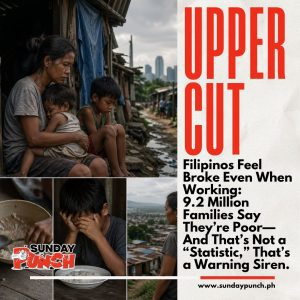
Around 9.2 million Filipino families (35%) now describe themselves as “poor,” based on OCTA Research’s March 2026 Tugon ng Masa survey. The share is slightly lower than December 2025’s 37%, but OCTA is blunt about it: the change is not statistically significant (within the ±3% margin of error). Translation: this isn’t a turnaround—this is still the same emergency, just with different decimals.
What should hit policymakers in the face is the map of it. Mindanao remains the hardest-hit at 56%, followed by the Visayas (44%), then Balance Luzon (25%), and Metro Manila (21%). Yes, NCR showed a notable drop (OCTA notes it fell by 12 points), and Mindanao also improved compared to its own December peak—but the bigger picture is ugly: regional inequality is loud, and it’s getting harder to ignore. If “Bagong Pilipinas” is real, it shouldn’t depend on your island group.
Then there’s the part people feel daily: food. 31% (about 8.1 million households) consider themselves “food poor”—basically saying, we’re one grocery run away from disaster. Involuntary hunger sits at 17% (around 4.5 million families), slightly up from 16% in December, again “statistically stable”—but that’s the point. Stable hunger is still hunger. And OCTA notes most of those affected experienced it “once or a few times” in three months—episodic, not constant—which is exactly how poverty works now: a rotating blackout of dignity.
Here’s the part leaders hate hearing: when 41% can’t even say if they’re poor or not, that’s not confusion—that’s precarity. That’s millions of families living in the “pwede pa” zone: technically surviving, but one illness, one layoff, one price spike away from falling through the floor. If the country keeps treating poverty like a PR graph, we’ll keep waking up to the same headline—just with a new number.