
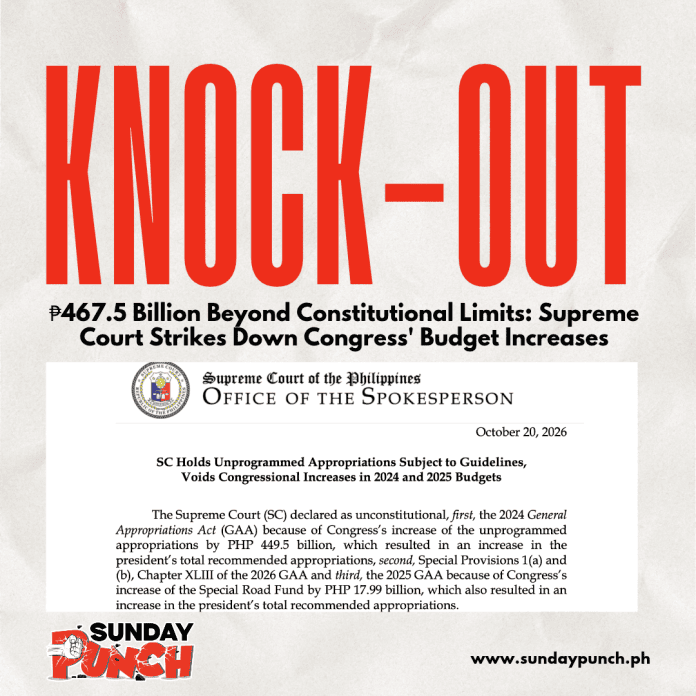
Nearly half a trillion pesos. That is the combined value of two congressional budget increases the Supreme Court has declared unconstitutional, raising serious questions about how the government authorizes spending on behalf of Filipino taxpayers. In a ruling announced on October 20, the country’s highest court struck down Congress’ ₱449.5-billion increase in unprogrammed appropriations under the 2024 national budget and a separate ₱17.99-billion increase in the Department of Public Works and Highways’ (DPWH) Special Road Fund for 2025. Together, the adjustments amounted to approximately ₱467.49 billion. To put that number into perspective, it is equivalent to nearly ₱1.28 billion every single day for an entire year, or more than ₱53 million every hour. These are comparisons of scale, not actual daily expenditures. But they underscore the extraordinary size of the appropriations involved. While ordinary Filipinos are expected to account for every peso in their household budgets, the Supreme Court has now ruled that lawmakers exceeded constitutional limits when increasing government spending authorizations worth hundreds of billions.
In a decision penned by Senior Associate Justice Marvic Leonen, the Supreme Court En Banc ruled that Congress violated constitutional restrictions by increasing total appropriations beyond the amount recommended by the President. The 2024 controversy centered on unprogrammed appropriations, which are standby spending authorizations intended for release only when specified funding conditions are satisfied. Congress increased the amount from the President’s proposed ₱281.9 billion to ₱731.4 billion, an additional ₱449.5 billion inserted during budget deliberations. The Court clarified that unprogrammed funds are not inherently unconstitutional, but they must operate within clearly defined fiscal limits and safeguards. The ruling also invalidated the ₱17.99-billion congressional increase in the 2025 Special Road Fund, which exceeded the proposed allocation. The underlying principle is straightforward: Congress possesses substantial authority over public spending, but that authority does not include ignoring the constitutional and statutory limits governing how the national budget is prepared.
What makes the ruling particularly consequential is the Supreme Court’s criticism of how budget changes were handled. The Court found deficiencies in the transparency and accountability of bicameral conference committee deliberations, noting the absence of adequate records explaining certain adjustments to spending proposals. It also raised concerns about lump-sum appropriations that could leave important spending decisions to be determined during budget implementation rather than subjected to proper scrutiny beforehand. These are not minor technicalities buried in government paperwork. Budget deliberations determine which public services receive funding, which projects move forward, and how much discretion officials possess over enormous sums of public money. When substantial adjustments lack sufficient documentation or clearly defined purposes, the public’s ability to understand how spending priorities were established becomes weaker. Apparently, when the figures reach hundreds of billions, asking for a proper explanation is not excessive scrutiny—it is precisely what accountability requires.
The Supreme Court’s decision also extended to the 2026 national budget, invalidating provisions governing the release of certain unprogrammed funds because they lacked adequate safeguards. The justices permanently prohibited the implementation of the affected provisions, reinforcing the requirement that standby appropriations must be tied to legitimate revenue conditions and defined spending priorities. Importantly, the ruling does not establish that the entire ₱467.49 billion was actually released, stolen, misappropriated, or lost to corruption. An appropriation authorizes spending; it does not automatically mean the money has been disbursed. Nor does a finding of unconstitutionality, by itself, establish criminal liability against individual lawmakers. Those distinctions matter. Nevertheless, the judgment raises legitimate questions about legislative oversight, the documentation of budget changes, and whether constitutional safeguards are being observed before enormous spending authorizations become law.
Ultimately, the controversy exposes a fundamental issue in public finance: the national budget is not simply a document containing trillions of pesos, but a statement of how government power and public resources are distributed. Every adjustment has implications for taxpayers who depend on public schools, hospitals, transportation systems, disaster protection, and other government services. The Supreme Court’s ruling reinforces that even Congress must operate within the legal boundaries established to protect those resources. The remaining challenge is ensuring that transparency does not begin only after questionable provisions reach the judiciary, but remains a requirement throughout the budget process itself. Filipinos should not have to wait for a Supreme Court decision to learn whether hundreds of billions in spending authorizations were added within constitutional limits. The money may be counted in billions, but the accountability must extend down to every peso.