
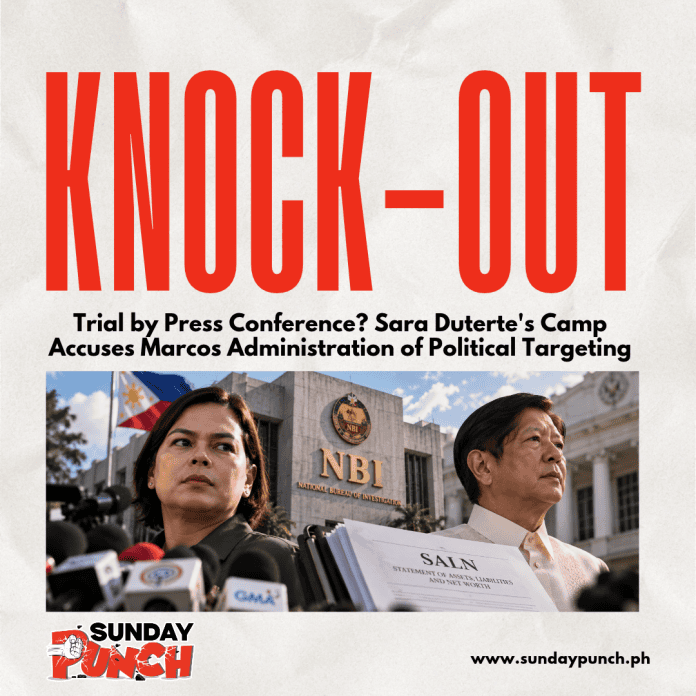
In a political climate where investigations can dominate headlines long before they reach a courtroom, Vice President Sara Duterte’s camp is raising a question that goes beyond the allegations against her: should government investigators publicly present potentially damaging findings before the subject has been given an opportunity to respond? On Friday, October 16, Duterte’s spokesperson, lawyer Salvador Paolo Panelo Jr., accused the Marcos administration of using the National Bureau of Investigation (NBI) to politically target the Vice President, describing its public presentation of alleged discrepancies in her Statements of Assets, Liabilities, and Net Worth (SALNs) as part of a campaign to discredit her.
Panelo specifically questioned NBI Director Melvin Matibag’s decision to discuss the findings in a series of press conferences without first formally informing Duterte and allowing her to address the allegations. He described the move as a “shameless smear campaign” funded by taxpayers, arguing that the bureau had effectively brought its findings before the public before giving the Vice President an opportunity to challenge them. Duterte has separately denied owning certain properties linked to her by investigators. The dispute raises a broader concern about the intersection of investigative authority and political publicity: an agency may have the responsibility to investigate public officials, but public accusations can carry reputational consequences even before any legal determination is reached.
The NBI, however, maintains that its findings are grounded in official documents rather than political speculation. Matibag said investigators compared Duterte’s asset declarations with land titles and other records, conducted property inspections, and identified possible inconsistencies requiring further evaluation. The bureau has referred its findings to the Office of the Ombudsman, which has the authority to assess whether further proceedings are warranted. Matibag also challenged Duterte’s camp to file a complaint if it believed he was acting with bias. While investigators are entitled to pursue legitimate questions about public officials’ wealth, the existence of discrepancies under investigation does not automatically establish deliberate misrepresentation or criminal wrongdoing.
The controversy also exposes a tension in political accountability: transparency is essential, but so is the distinction between presenting evidence and establishing guilt. Press conferences can inform the public about government investigations, yet they can also shape perceptions before the individuals concerned have formally answered the findings. That concern becomes particularly consequential when the subject is a sitting Vice President whose relationship with the administration has deteriorated into open political conflict. In today’s political arena, the court of public opinion rarely waits for the actual court—and reputational verdicts can arrive considerably faster than legal ones.
Ultimately, the dispute is not simply about whether Duterte’s asset declarations deserve scrutiny; public officials are accountable for the accuracy of their disclosures. It is also about whether government institutions can demonstrate impartiality while conducting politically sensitive investigations. The NBI’s findings must withstand independent evaluation, just as Duterte’s explanations must withstand examination of the underlying records. Until the appropriate authorities determine the merits of the allegations, neither political persecution nor financial wrongdoing can be treated as established fact. The challenge for both sides is to ensure that the pursuit of accountability does not become indistinguishable from the battle for public opinion.