
By: Raymond Dimayuga
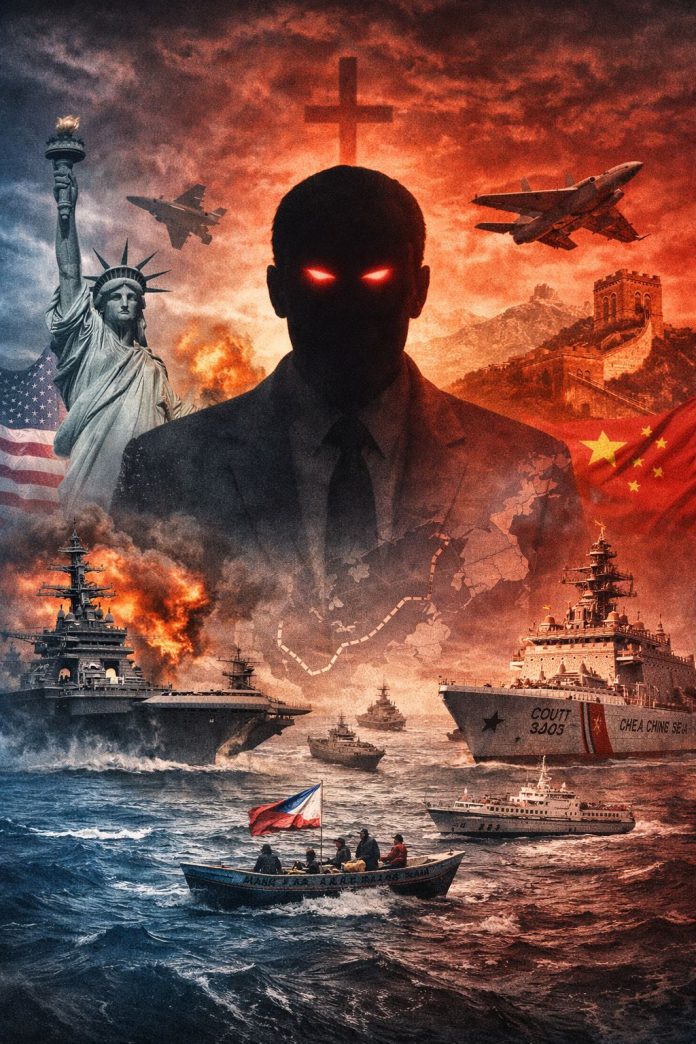
Throughout history, humanity has imagined the arrival of the anti-Christ: a figure of immense power who would dominate the world not through horns and fire, but through influence, authority, and persuasion. The anti-Christ, in many interpretations, would not appear as a monster. He would appear as a leader. A savior to some. A tyrant to others.
But in a world shaped by geopolitics rather than prophecy, one cannot help but wonder: if such a figure emerged today, from where would he come?
Perhaps from a superpower.
Perhaps from a nation that believes its destiny gives it the right to reshape the world.
Two countries inevitably enter this uncomfortable thought experiment: China and the United States.
China has, in recent years, asserted sweeping claims over vast portions of the South China Sea, territories long recognized as belonging to other sovereign nations. Fishing boats are chased away. Maritime patrols confront smaller neighbors. Artificial islands rise from the water like monuments to territorial ambition.
For countries like the Philippines, Vietnam, and Malaysia, the message often feels unmistakable: power determines reality.
International rulings, such as the 2016 arbitral tribunal decision rejecting China’s sweeping claims, have not softened Beijing’s position. The sea lanes remain tense. The region remains uneasy.
Yet China is not alone in wielding global influence in ways that spark resentment.
Across the Pacific stands the United States, long self-styled as the defender of democracy and freedom. But critics argue that Washington often behaves less like a partner and more like a global referee who appoints itself the authority to intervene anywhere.
From military interventions to economic sanctions, America’s reach stretches across continents. To its allies, this presence is reassurance. To its critics, it can feel like overreach.
The United States sees itself as the world’s police.
China sees itself as reclaiming its rightful place in history.
Between these two visions lies a planet navigating competing empires of influence.
Neither country is purely villain nor hero. Each carries its own narrative of righteousness. China frames its actions as historical correction. America frames its actions as global responsibility.
But power, when left unchecked, has a way of convincing itself that its intentions justify its actions.
History has repeatedly shown that empires rarely see themselves as villains. They see themselves as necessary.
And perhaps that is the most unsettling thought of all.
The anti-Christ, if he ever walked the earth, would not necessarily declare himself an enemy of humanity. He might claim to bring order, stability, and peace. He might speak of security, prosperity, and destiny.
Many would follow him.
Others would resist.
The danger of power is not simply domination. It is the belief that domination is justified.
In a world of rising superpowers and shrinking restraint, humanity may not need prophecy to warn us about the risks of absolute influence. We only need to watch the daily headlines.
The real question may not be whether the anti-Christ would come from America or China.
The real question is whether the world has learned enough from history to recognize the dangers of power before it becomes something far darker.
—
Eat the Worm is a weekly column that dives headfirst into unconventional ideas, uncomfortable truths, and the gritty realities we often shy away from. Much like the brave tradition of “eating the worm” in a tequila bottle, this column challenges readers to confront the hard stuff with courage and curiosity. This is a fearless exploration of life’s rawest and most compelling topics.