
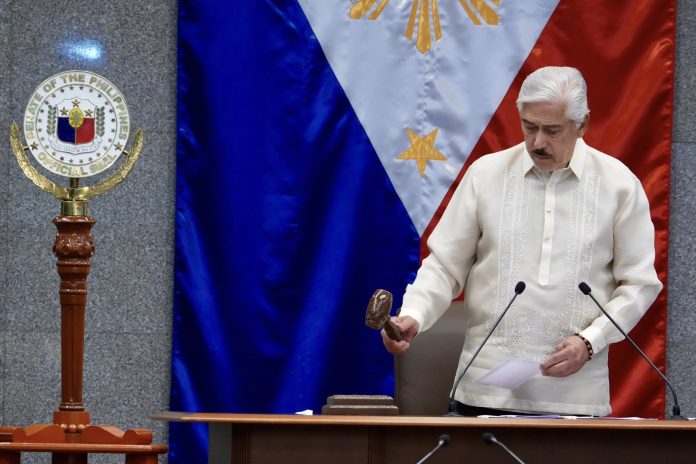
The Senate moved as one on Wednesday, swiftly adopting a leadership-backed resolution to create an ad hoc body that will craft proactive responses to emerging crises.
The chamber approved Senate Resolution No. 350, authored by Senate President Vicente Sotto III, Majority Leader Juan Miguel Zubiri, and Minority Leader Alan Peter Cayetano, signaling a coordinated national action amid rising global and domestic threats.
Senators voiced firm support, stressing the need to act early rather than respond late. Several lawmakers described the measure as timely, citing risks linked to tensions in the Middle East that could affect oil supply, jobs, and prices.
Members of the Minority Bloc, including Senator Rodante Marcoleta, called the resolution “a timely and necessary measure,” anchored on preparedness.
Senator Joel Villanueva expressed appreciation to the authors of the measure, calling the initiative “very timely and important.”
Senator Robinhood Padilla emphasized the need for unity across government agencies, while Senator Sherwin Gatchalian highlighted the importance of acting early.
Under the resolution, the Senate will form the Proactive Response and Oversight for Timely and Effective Crisis Strategy (PROTECT), an ad hoc body composed of chairpersons of all Senate committees, including those handling key sectors such as agriculture, energy, and trade.
The panel is tasked to help develop a comprehensive national contingency plan.
The initiative aims to improve coordination among national agencies, local government units, and the private sector, while program implementation will remain with the Executive branch.
The measure builds on an earlier resolution urging the Executive to establish a national contingency framework, amid rising global tensions threatening oil supply, jobs, fuel prices, and overall economic stability.
The ad hoc committee is expected to conduct hearings, gather inputs from key sectors, and submit recommendations to the Executive branch to ensure the country is better prepared for future crises.