
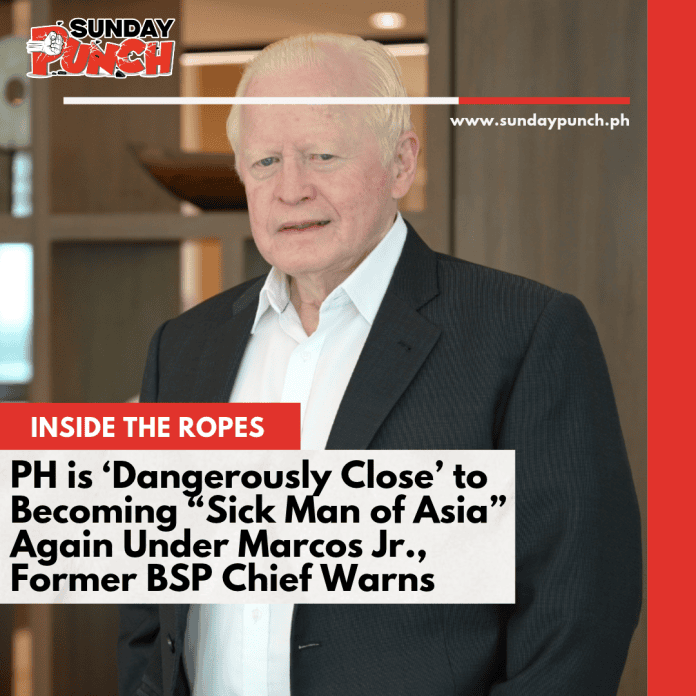
The Philippines is dangerously close to regaining its reputation as the “Sick Man of Asia” under President Ferdinand Marcos Jr., according to former Bangko Sentral ng Pilipinas (BSP) Governor Jose Cuisia Jr. In an interview on ANC’s Beyond the Exchange, Cuisia warned that mounting government debt, corruption allegations, weakening investor confidence, and poor fiscal management could push the country toward another period of economic decline. He stressed that recovery remains possible, but only if the government takes decisive action to address its worsening economic challenges.
Cuisia raised particular concern over the country’s rising debt burden, which reached 66.9% of gross domestic product (GDP) by the end of September 2026, its highest level in 22 years. The figure is substantially higher than the approximately 40% debt-to-GDP ratio recorded before the pandemic and exceeds the 60% benchmark frequently used in assessing fiscal risks. Cuisia argued that government spending has outpaced available revenues, placing greater pressure on public finances and raising concerns about the country’s ability to sustain its obligations.
The former central bank chief also pointed to alleged corruption involving government infrastructure projects as a major threat to economic confidence. He cited controversies surrounding public spending and the flood control scandal, arguing that suspected misuse of public funds has damaged the Philippines’ reputation among foreign investors. Cuisia further expressed concern over weakening foreign direct investment and portfolio inflows, warning that persistent governance problems could discourage businesses from investing in the country. His claims about corruption remain allegations, with responsibility for specific irregularities subject to investigation and legal proceedings.
Cuisia urged the Marcos administration to adopt a more disciplined national budget, strengthen anti-corruption efforts, and prioritize investments in agriculture and essential infrastructure to restore economic confidence. His warning draws a historical parallel with the economic crisis of the 1980s under former President Ferdinand Marcos Sr., when the Philippines struggled with heavy debt, political instability, and prolonged economic weakness. While Cuisia believes the country can still avoid repeating that experience, he stressed that stronger governance, responsible spending, and policies that attract investment are necessary to reverse the current trajectory.
Image from PHINMA