
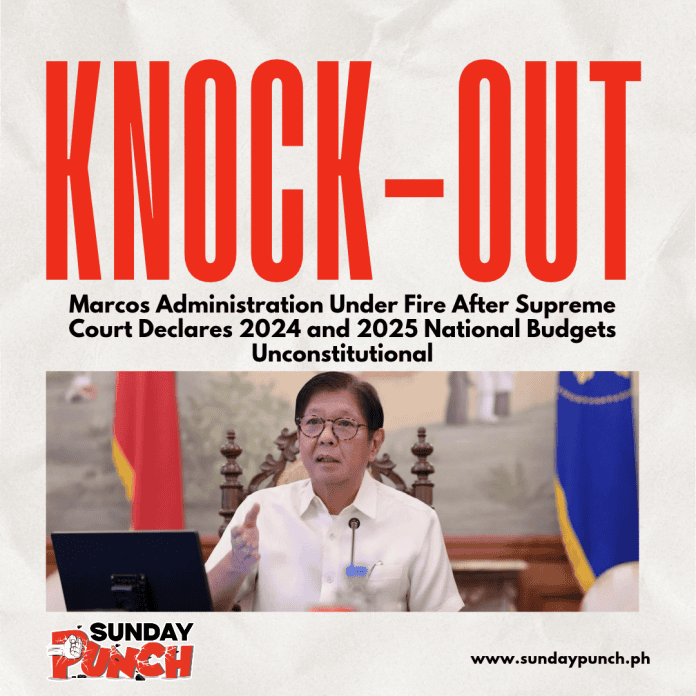
President Ferdinand Marcos Jr. and Congress are facing mounting demands for accountability after the Supreme Court declared the 2024 and 2025 national budgets unconstitutional, exposing serious violations of constitutional limits on government spending. In a decision penned by Senior Associate Justice Marvic Leonen, the High Court struck down a ₱449.5-billion increase in unprogrammed appropriations under the 2024 budget and a ₱17.99-billion increase in the Department of Public Works and Highways’ Special Road Fund under the 2025 budget. The Court also invalidated provisions governing unprogrammed funds in the 2026 budget, reinforcing constitutional safeguards against excessive and insufficiently regulated public spending.
Vice President Sara Duterte challenged Marcos to explain why he signed the questioned budgets into law, arguing that public funds must serve Filipinos rather than political interests. ACT Teachers Rep. Antonio Tinio likewise accused the executive and legislative branches of enabling questionable spending arrangements, particularly amid the ongoing flood-control corruption controversy. Other lawmakers, including Leila de Lima, Chel Diokno, and Toby Tiangco, raised concerns over opaque allocations and weak congressional scrutiny. The ruling has also intensified questions surrounding the proposed ₱7.2-trillion 2027 national budget, with lawmakers warning that questionable lump-sum provisions and insufficiently documented allocations could invite further constitutional challenges.
The decision places renewed pressure on the Marcos administration, but the Supreme Court has not ruled that the President or individual lawmakers committed corruption or are personally liable. Any criminal, civil, or administrative responsibility would require separate proceedings and supporting evidence. Malacañang, through Palace Press Officer Claire Castro, defended Marcos against suggestions of personal liability and announced plans to seek reconsideration of parts of the ruling. Nevertheless, the Court’s findings raise a substantial accountability question for both branches of government: how were spending increases worth hundreds of billions of pesos approved despite constitutional restrictions, and what safeguards will prevent similar violations in future budgets?
Image from Presidential Communications Office