
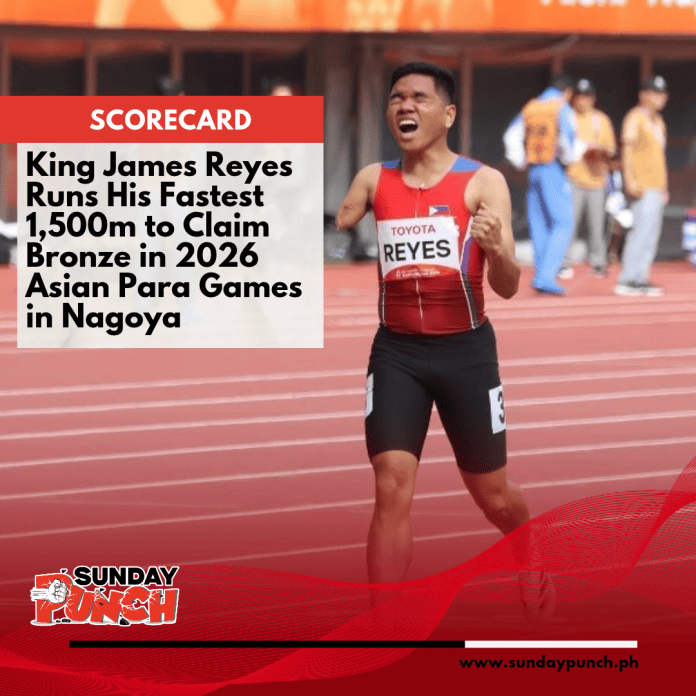
At five years old, King James Reyes suffered a life-changing accident after falling from a macopa tree and losing his right arm. Nearly two decades later, he stood on an international podium, wearing a medal for the Philippines and celebrating the fastest race of his career. The 24-year-old Filipino para-athlete captured bronze in the men’s 1,500-meter T46 event at the 2026 Asian Para Games in Nagoya, Japan, on Friday, October 23, finishing in a personal-best time of four minutes and 13.81 seconds. For the proud son of Loreto, Agusan del Sur, the achievement represented years of training, discipline, and determination coming together on one of Asia’s biggest sporting stages. What began as a childhood marked by a devastating injury has grown into a remarkable athletic career, and Reyes is making sure his story is defined not simply by what happened to him, but by everything he has accomplished since.
Competing at Mizuho Park Athletic Stadium, Reyes faced some of Asia’s strongest para-middle-distance runners and secured third place with a performance that surpassed his previous personal record. Sri Lanka claimed the gold medal in 4:03.25, while India’s Parmod earned silver in 4:09.65. Reyes crossed the finish line in 4:13.81, adding another international medal to a career that already includes two gold medals from the ASEAN Para Games. The bronze also strengthened the Philippines’ campaign at the continental competition, where Filipino para-athletes have been making their mark across swimming, athletics, and other disciplines. Yet beyond the national medal count, the most meaningful number for Reyes was his own finishing time. Even against a field strong enough to keep him from gold, he delivered the best 1,500-meter performance of his career. And in competitive sports, reaching a new personal best on such an important stage is a victory worth celebrating.
Reyes was quick to acknowledge the faith, training, and sacrifices behind his achievement. “Sa tulong ni God, hindi po naging hadlang ang kapansanan ko para maabot ko ang aking mga pangarap,” he said, expressing gratitude for the opportunities he has pursued despite the challenges he has faced. He also celebrated setting a personal record, crediting the work he and his team invested in preparing for the competition. His success is especially inspiring because Reyes is balancing his athletic career with his education as a graduating Sports Science student at Adamson University. His journey illustrates the dedication required of athletes who pursue competitive excellence while working toward goals beyond the sporting arena. Every second shaved from a race time represents countless training sessions, adjustments, and lessons that rarely receive the same attention as the final medal ceremony.
His achievement also comes at a meaningful moment for Philippine para-sports. The country’s delegation has earned medals through the efforts of athletes including swimmers Ernie Gawilan, Ariel Joseph Alegarbes, and Raemond Adefuin, demonstrating the depth of talent representing the Philippines at the Games. Meanwhile, fellow Filipino competitors have continued pursuing podium finishes across different disciplines, with some delivering personal-best performances even without medals. Reyes’ bronze adds another accomplishment to that collective campaign while drawing attention to the importance of sustained training opportunities, coaching, facilities, and institutional support for Filipino para-athletes. Inspirational stories deserve celebration, but sporting excellence is also built through practical resources and consistent preparation. Reyes’ performance is a reminder that para-athletes should be recognized not only for the personal obstacles they have overcome, but for their technical abilities, competitive achievements, and contributions to Philippine sports.
Ultimately, King James Reyes’ bronze medal represents far more than a third-place finish. It is the culmination of years spent developing his abilities, pursuing his education, and working toward international success. His childhood accident remains an important part of his life story, but it does not diminish the skill and effort that carried him to the podium in Japan. Today, he is a two-time ASEAN Para Games gold medalist, an Asian Para Games bronze medalist, a graduating university student, and a Filipino athlete with a new personal record to his name. For young Filipinos watching from home, his journey offers a powerful example of what sustained determination and opportunity can achieve. And for Reyes himself, the result provides another milestone to build upon as he continues his athletic career. The bronze medal may mark where he finished in the race, but his personal best shows just how far he has come—and how much more he may still achieve.