
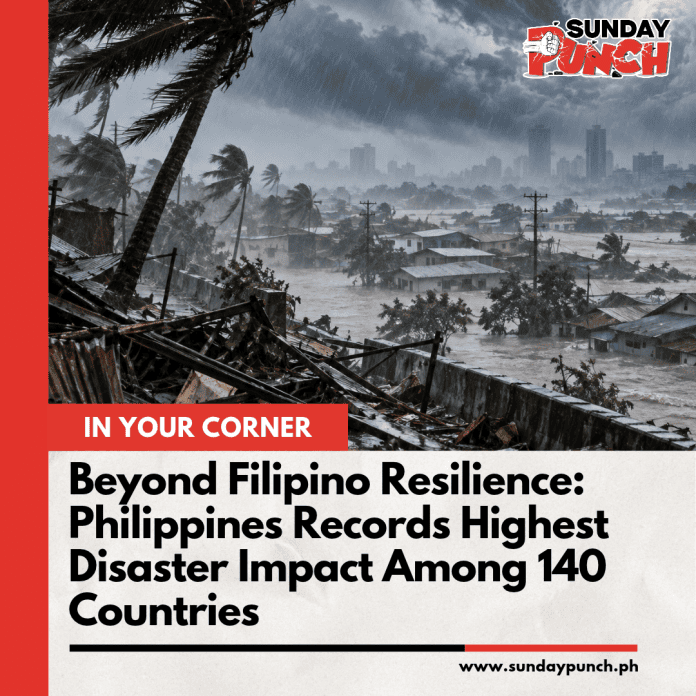
For millions of Filipinos, disaster is not a distant possibility discussed in weather forecasts. It is the floodwater that enters their homes, the typhoon that destroys their livelihood, the earthquake that forces them outdoors, or the evacuation that interrupts another ordinary day. Now, a major international survey has revealed just how widespread those experiences have become. The Philippines recorded the highest reported disaster impact among 140 countries and territories in the 2026 World Risk Poll, with a staggering 80% of Filipino adults saying they had personally been affected by a disaster related to natural hazards within the preceding five years. Conducted by Gallup for Lloyd’s Register Foundation, the survey found that only 20% of adults globally reported similar experiences. In other words, the Philippine figure was four times the global average. The finding paints a troubling picture of a country where living through a disaster is no longer an exceptional experience for many households, but an increasingly familiar part of everyday life.
Tropical storms were the most widely reported source of disaster impact in the Philippines, affecting 52% of surveyed adults. The burden, however, varied considerably by location. In the Visayas, 67% reported being affected by tropical storms, followed by 59% in Luzon outside Metro Manila. Within the National Capital Region, 44% reported storm-related impacts, while 39% cited flooding. Mindanao faced a different pattern, with 44% of respondents reporting earthquake-related impacts. These regional differences illustrate why the country’s disaster challenges cannot be addressed through a single approach. Coastal communities confront storm surges and rising seas, urban neighborhoods struggle with flooding, agricultural provinces face damage to crops and infrastructure, and earthquake-prone areas must prepare for sudden ground movement. The hazards may differ, but the consequences often reach the same vulnerable parts of daily life: housing, food security, transportation, employment, education, and access to essential services.
The Philippines’ position becomes even more striking when compared with other heavily affected countries. Zambia ranked second with 66% of adults reporting disaster impacts, followed by Chad at 58% and Mozambique at 55%. The Philippines stood 14 percentage points above the next-highest country. According to Gallup’s analysis, people in lower-income economies generally experience greater disaster impacts while having fewer resources to prepare for and recover from emergencies. But the Philippine result goes beyond a comparison of national rankings. It raises serious questions about how effectively vulnerable communities are protected before hazards become catastrophes. A powerful storm may be unavoidable, but whether families have structurally safe homes, accessible evacuation facilities, functioning drainage systems, reliable warnings, and sufficient recovery support can significantly influence the harm they experience. Natural hazards are part of the country’s geography; the scale of human suffering that follows them is also shaped by preparedness, infrastructure, and public policy.
Equally concerning is the difference between knowing that danger is approaching and having the means to escape it. Separate findings from the 2026 World Risk Poll showed that, worldwide, approximately four in five disaster-affected adults received at least one advance warning. Yet more than one-third of those warned were unable to take protective action. The research also found that adults who had both a household disaster plan and confidence in their ability to protect themselves were considerably more likely to act on warnings than those who had neither. These global findings do not establish the exact preparedness level of Filipino households, but they highlight a crucial challenge for disaster management: information alone cannot protect someone who lacks safe transportation, emergency savings, accessible evacuation facilities, or a home capable of withstanding severe weather. An early warning has limited value when the person receiving it has nowhere safe to go. For Philippine authorities, the implications extend beyond improving forecasts and emergency announcements to strengthening the practical resources communities need before an emergency begins.
The latest findings arrive as the country faces continuing environmental pressures, including severe weather risks, recurring floods, earthquakes, and concerns surrounding a developing El Niño episode. But perhaps the most important message of the survey is that disaster resilience cannot be measured only by how quickly relief goods are distributed after a calamity. Effective protection begins much earlier—with safer housing, enforced building standards, stronger drainage and flood-control systems, land-use planning, reliable evacuation facilities, and sustained investment in disaster preparedness. The survey does not establish that every reported disaster was caused by climate change, nor does it prove that the Philippines suffered the greatest financial losses or number of deaths worldwide. What it does establish is an extraordinary level of reported personal exposure among Filipino adults. And that alone deserves national attention. Filipinos should be praised for helping one another through calamities, but resilience must never become an excuse to accept repeated suffering as normal. The real achievement is not simply surviving the next disaster—it is building a country where fewer people have to.