
By REX C. CATUBIG
Walking back to my old school (1st of 2 parts)
Note: Before T Ayson Rosario Elementary School came to be, we had Calmay Primary School. The inauguration of the new school building which was built under the education program of Mayor Belen T Fernandez, triggered an avalanche of memories of my early schooling and grateful thoughts on the new school. Thank you to my barriomates Conchita Cendana, Joe Damaso and Nonong Escosio for helping to piece together my recollection of people and places.
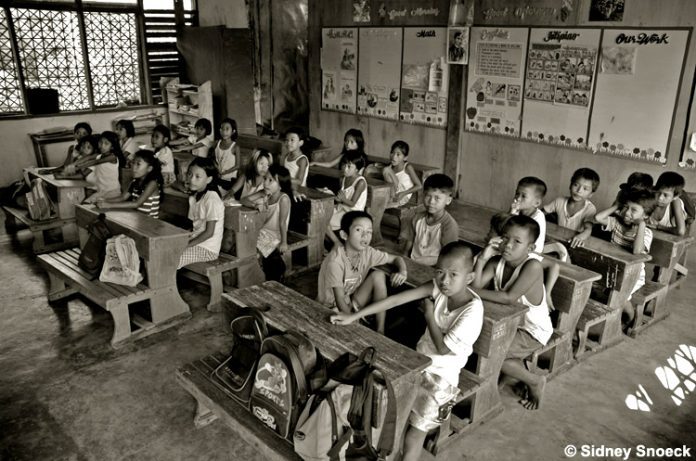
I studied for the first four years of my early education in Calmay Primary, a squat 5-room wood structure on the riverbank of Calmay river, a stone’s throw from the remnants of Colegio de San Alberto Magno—bordering Iloko or Calmay Norte, the unique Ilocano enclave.
It had four classrooms, one for each grade, with a fifth room, an office cum clinic. It was about 25 meters long with a 3-meter wide staircase front center– its 4 steps probably in keeping with the “Oro, plata, mata” folk formulary for good luck.
An open corridor with wood rails ran along the entire length. A meter deep, the central section at the top of the staircase served as a stage for school programs.
The Grade 1 classroom had a 4X8 feet blackboard against the wall. Thumbtacked above were cardboards printed with caps and lower cases of “Aa, Ba, Ka, Da” and A, E, I, O, U. Chalks and an eraser were placed on the bottom ledge.
The two dozen or so of us pupils sat in 2 columns of 4 desks spread over 3
I was here from Grade 1 to 4. For Grades 5 and 6, I went to West Central in the Poblacion instead of the Carael Elementary in the neighboring barrio.
My school day starts at our Batalan, the wash area at the back of our house in Calmay Centro. Shaded by a wide canopied Acacia tree, it looked out directly to the fishpond of Mama Lucio Quides, and overlooked the geometric grid of other fishponds all the way to the western horizon.
It’s where I would wait for my classmate Victoriano Daligdig, who lived in barrio Lomboy yonder. He hiked daily across the labyrinthian mud dikes to fetch me and together we would walk briskly for our 7 o’clock class.
It was no more than three hundred meters and took just under ten minutes, along a narrow pathway bordered by an open canal where household sewage emptied onto the river.
Along the way, we passed the house of our classmate Romeo, son of Mama Sianong, Marciano de Vera Cendana, who graduated and taught at the Colegio de San Alberto Magno.
At the end of this route, around the bend to the left, was the store of my classmate Lina’s parents, Pacing and Paeng Santiago—bounded by a row of wood square boxes heaping with mounds of rice, emek, mais, babang, and copras. Emery Corned Beef, Portola Sardines in oblong tins, Purico, reams of Fighter and other cigarettes, among other sundries vied for attention from the wall shelf, while a dangling Kulkuldit poster waved from a corner of the ceiling.
Across on the right side of the gravel road towards Boquig or north, was the sari sari of Mama Tomas Carerra; next to it was the quaint Chinese botica of Mama Ong or Tsonga, the immigrant oddity in our barrio. The row then opened to the Iloko boat dock which bordered the house of my classmate Rosario “Ninit” Quitiquit, one of two lovely daughters of Mariano Quitiquit.
On the parallel side, were the neighboring houses of Tia Dorang Paragas and Tia Yaw Acacio; and not to be missed was the iconic bakery of Mama Mateo Escosio with its domed brick oven, guarded by a Melendres tree whose fragrant flowers rivaled the scent of baking bread. Adjacent was the house of single teacher Gening Quimboy, with the yard of Ramon Ayson farther.
In this little universe, on a dirt yard owned and later donated by Manila-based Calmay pioneer Temistocles Ayson Rosario, nestled Calmay primary, as if docked on the riverbank. Yet amid this humble setting, it evoked a lofty sense of pride and honor, seen in our bright smiles and heard in our exuberant thick accent when we greeted one another: “Good morning, Madam! Good morning, classmates!”.
Even then, in the infancy of our school years, our exultant voices soared across the ages and carried the promise of tomorrow.