
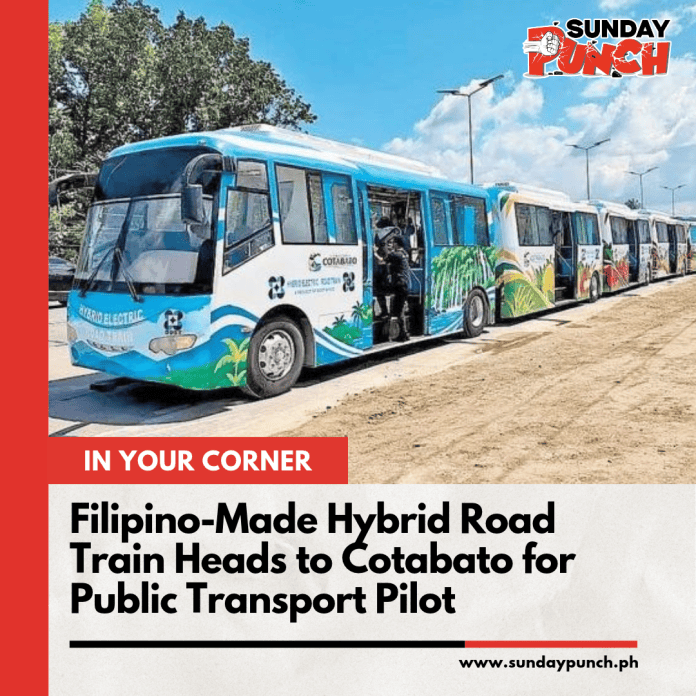
The Department of Science and Technology (DOST) has turned over a locally developed Hybrid Electric Road Train (HERT) to the provincial government of Cotabato, paving the way for a new public transportation option in Mindanao. The five-coach vehicle was officially handed over on November 27, 2026, in Kidapawan City, making Cotabato its first pilot deployment site in Mindanao. Developed by the DOST-Metals Industry Research and Development Center, the road train combines diesel and electric power and features interconnected, air-conditioned coaches designed to transport multiple passengers along public roads.
The provincial government plans to initially operate the road train along a 10-kilometer route connecting Kidapawan City and Matalam, with free rides intended for students during the pilot phase. Cotabato Governor Emmylou Taliño-Mendoza said authorities would need approximately one month to assess passenger loading and unloading stations before beginning operations. Officials will also evaluate the possibility of extending the service toward Kabacan and Carmen, potentially expanding transportation access to more communities in the province.
The project highlights the potential of Filipino-developed technology to address public transportation challenges while supporting more sustainable mobility. DOST recently upgraded the road train’s energy storage system by replacing its lead-acid batteries with lithium-ion batteries and introducing a new battery management system intended to improve efficiency, safety, and service life. Each coach reportedly costs approximately ₱9 million to manufacture, although officials believe production costs could decrease if the technology is eventually mass-produced.
DOST Secretary Renato Solidum Jr. also raised the possibility of deploying the road train along Metro Manila’s EDSA Bus Carousel, although no implementation plan has been approved. Solidum emphasized that any expansion would require coordination with local government units and transportation authorities. The technology has previously undergone demonstrations in Metro Manila and deployments in Isabela, with Cotabato’s upcoming pilot expected to provide further insights into its practicality. For commuters, the initiative represents a potential alternative to conventional buses, although its effectiveness will depend on successful testing, route planning, and sustained operational support.