
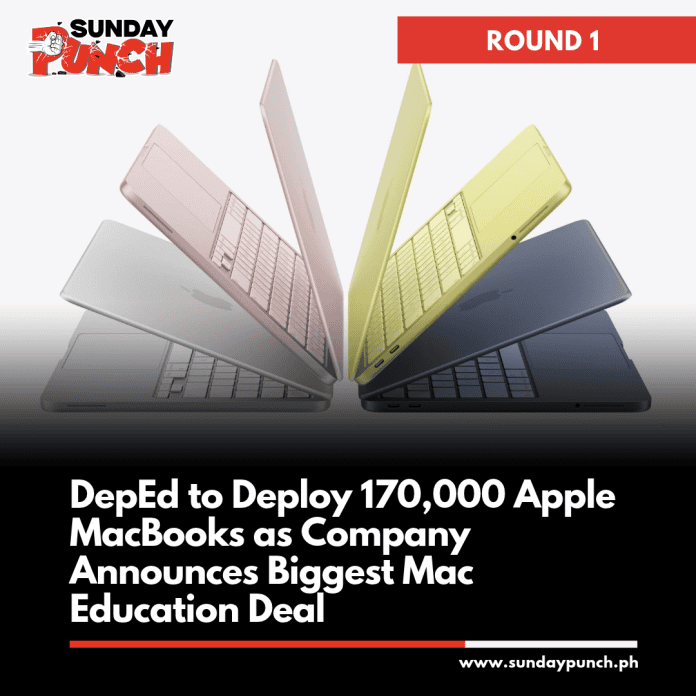
The Department of Education (DepEd) is set to deploy 170,000 Apple MacBook Neo laptops to public school teachers and personnel nationwide, marking what the technology giant describes as its largest education agreement involving Mac computers. Apple Chief Executive Officer John Ternus announced the deal during the company’s quarterly earnings call on November 2, highlighting the Philippines as a major market for its education technology products. Ternus, who succeeded Tim Cook as CEO in September, said the devices would be distributed to teachers and staff. The announcement represents a significant investment in educational technology, although the government has yet to publicly disclose how much the procurement will cost.
The MacBook Neo, introduced in March 2026 as Apple’s most affordable laptop, features an A18 Pro processor, a 13-inch Liquid Retina display, and built-in applications for document preparation, presentations, and other everyday tasks. The planned deployment could help educators prepare lessons, manage school records, and integrate digital resources into classroom instruction. However, with the Philippines employing nearly 900,000 public school teachers, the announced quantity would not be enough to provide one laptop to every teacher, even if all 170,000 units were allocated exclusively to teaching personnel. The rollout therefore raises practical questions about which schools and employees will receive the devices first, how recipients will be selected, and what technical support will accompany the distribution.
Despite Apple’s announcement, DepEd has not yet publicly detailed the contract’s total value, negotiated price per laptop, exact hardware specifications, procurement arrangements, or delivery timetable. Those details will be important in assessing whether the purchase offers value for public funds, particularly given the scale of the acquisition and the need to maintain devices over several years. Beyond the number of computers acquired, the initiative’s success will ultimately depend on equitable distribution, teacher training, reliable internet access, and the availability of maintenance and repair services. For a deal involving 170,000 government-procured laptops, the next major question is not simply how many devices are coming, but how effectively they will be used—and at what cost to taxpayers.