
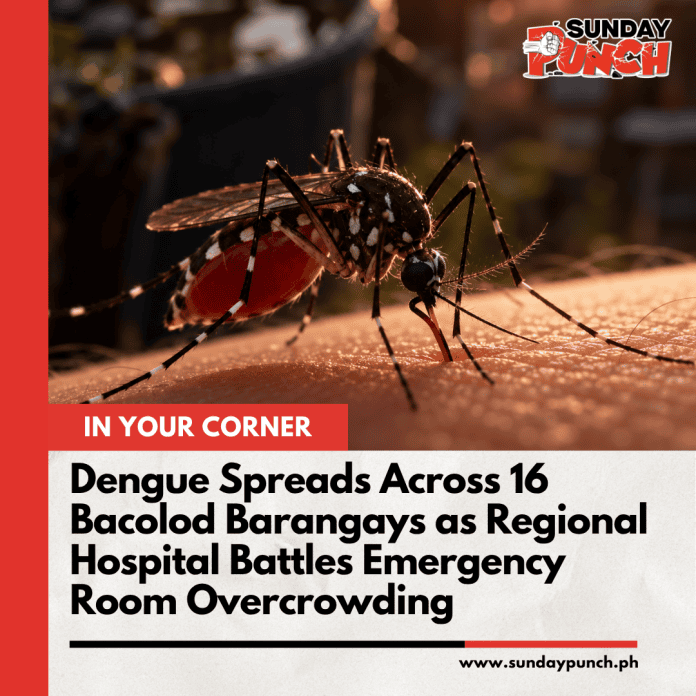
A mosquito may be small, but the public health challenge it represents is becoming increasingly difficult to ignore in Bacolod City. Corazon Locsin Montelibano Memorial Regional Hospital (CLMMRH) has issued a dengue alert after recording 50 admissions from October 1 to 14, just as its emergency department struggles with severe overcrowding. The convergence of these developments raises a troubling question: what happens when a preventable mosquito-borne disease adds pressure to a healthcare facility already operating beyond its intended capacity? Dengue may begin with something as ordinary as stagnant water, but its consequences can extend far beyond the household and into an already strained hospital system.
According to an October 16 report by Digicast Negros, 38 of the hospital’s 50 dengue admissions, or 76%, involved patients from Bacolod City, representing 16 barangays. Barangay Handumanan recorded the highest number among these admissions at six, followed by Taculing and Bata with five each. The hospital urged residents to eliminate mosquito breeding sites, regularly empty containers holding stagnant water, use repellents containing DEET or picaridin, and seek medical attention at the first sign of fever. The figures describe admissions to CLMMRH during the reporting period, not the total number of dengue infections throughout the city. Nevertheless, the distribution across multiple communities highlights why dengue prevention cannot be treated as an isolated household responsibility. Mosquitoes, after all, do not recognize property lines, barangay boundaries, or whose turn it is to clean the drainage.
The warning becomes more concerning when considered alongside a separate hospital advisory issued on October 14. CLMMRH reported that its emergency department had reached 212% occupancy, with 138 patients seeking treatment in a facility designed for 65 beds. Hospital officials urged patients with non-life-threatening conditions to consider local health centers and other appropriate healthcare facilities while assuring the public that emergency services remained operational. The hospital did not attribute the overcrowding specifically to dengue, and the two figures should not be interpreted as evidence that dengue caused the congestion. However, they illustrate the challenge of responding to additional disease-related demand when emergency resources are already stretched. An overflowing emergency department is hardly the ideal backdrop for another public health warning.
The broader dengue situation in Bacolod makes the issue even more urgent. According to an October 13 report by Bombo Radyo Bacolod citing the City Health Office, six dengue-related deaths had been recorded during the September 27 to October 3 reporting period, including an eight-year-old girl from Barangay Handumanan. The report also identified Mansilingan as the barangay with the highest cumulative case count as of October 3. These citywide surveillance figures cover a different period and reporting system from CLMMRH’s admissions, but together they reinforce the seriousness of the disease. The challenge extends beyond reminding residents to empty flowerpots and cover water containers. Effective prevention also depends on coordinated community sanitation, disease surveillance, accessible healthcare, and timely public health interventions. Personal responsibility matters, but a citywide health threat demands more than individual reminders.
Ultimately, Bacolod’s dengue warning presents two interconnected public health concerns: preventing infections before they occur and ensuring that healthcare facilities can respond when prevention fails. Residents have an essential role in removing breeding sites and seeking prompt medical consultation, while health authorities face the continuing responsibility of coordinating prevention efforts and managing healthcare demand. The reported hospital congestion does not establish negligence or inadequate dengue response, but it underscores how limited medical capacity can complicate public health emergencies. The lesson is straightforward: dengue prevention should not begin only when patients start filling hospital beds. By then, the mosquito has already done its part—and the healthcare system is left carrying the consequences.