
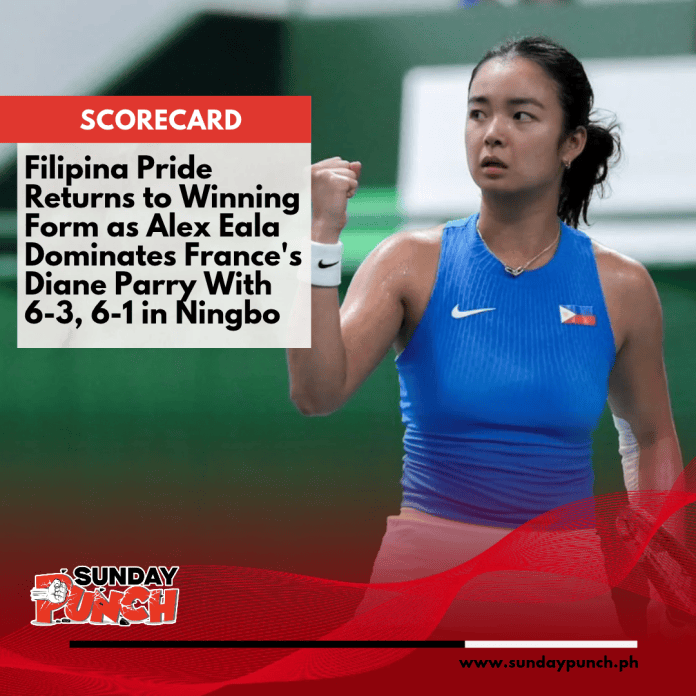
Three consecutive defeats may have interrupted her momentum, but they were never going to erase what Alex Eala has accomplished for Philippine tennis. The 21-year-old Filipina delivered an emphatic response to her recent setbacks on October 19, defeating France’s Diane Parry, 6-3, 6-1, in the opening round of the WTA 500 Ningbo Open in China. The victory marked Eala’s first WTA Tour win since the US Open and sent her into the tournament’s round of 16. For a rising athlete carrying the expectations of a nation, the result offered something more meaningful than relief from a losing streak: a reminder that champions are not defined solely by how often they win, but by how they respond when victories become harder to find.
Ranked world No. 20, Eala faced a competitive opening set against the 34th-ranked Parry, with both players exchanging service breaks before reaching a 3-3 deadlock. From there, the Filipina took control, winning seven consecutive games to claim the first set and establish a commanding 4-0 lead in the second. Eala eventually closed out the match in just one hour and 17 minutes, converting six of nine break-point opportunities. She also displayed greater consistency, recording 12 winners against only nine unforced errors, compared with Parry’s 11 winners and 25 errors. The performance was not simply about overpowering an opponent; it demonstrated the composure and precision needed to turn a closely contested match into a convincing victory.
The win carries particular significance given Eala’s remarkable journey throughout the 2026 season. Earlier this year, she made history by becoming the first Filipino to capture a WTA Tour-level singles title, defeating American Jessica Pegula in the Washington Open final. She subsequently reached a career-high world ranking of No. 18, establishing another milestone for Philippine tennis. However, her recent Asian swing brought difficult results, including losses in Singapore and Wuhan, while her Asian Games campaign ended with a bronze medal after a semifinal defeat. Those setbacks attracted attention precisely because Eala had already raised expectations through her achievements. Yet there is something worth remembering about the pressure surrounding a breakthrough athlete: the more history someone makes, the faster ordinary losses can begin to look like extraordinary disappointments.
Following her Ningbo victory, Eala expressed satisfaction with her performance and acknowledged the challenge presented by Parry. She also thanked supporters who continued cheering for her through difficult moments, saying their encouragement made competing more enjoyable. Her appreciation reflects a growing connection between the young tennis star and Filipino audiences who follow her across international tournaments. But support for an athlete should not depend entirely on an uninterrupted winning streak. Eala’s recent defeats did not diminish her historic Washington title, just as her latest victory does not guarantee another championship. What it does demonstrate is her ability to regroup, adjust, and compete effectively against established international opponents. The Philippines has a player capable of making history, but it also has a young professional who deserves room to develop between those milestones.
Eala now advances to the round of 16, where she is set to face the winner of the opening-round encounter between sixth-seeded Diana Shnaider and Yulia Putintseva. The next match will present another test as she seeks to build on her renewed momentum in Ningbo. Regardless of how far she progresses, her latest performance offers a timely perspective on the realities of professional tennis: even the world’s leading competitors experience defeats, fluctuations in form, and periods of uncertainty. For Philippine sports, Eala’s achievements represent more than a collection of rankings and tournament results. They demonstrate that a Filipina can compete, win titles, and command respect on one of the world’s most demanding international sporting circuits. She may not win every match, but every time she steps onto the court, she continues to show that Philippine tennis belongs in the conversation.
Image POC Media