
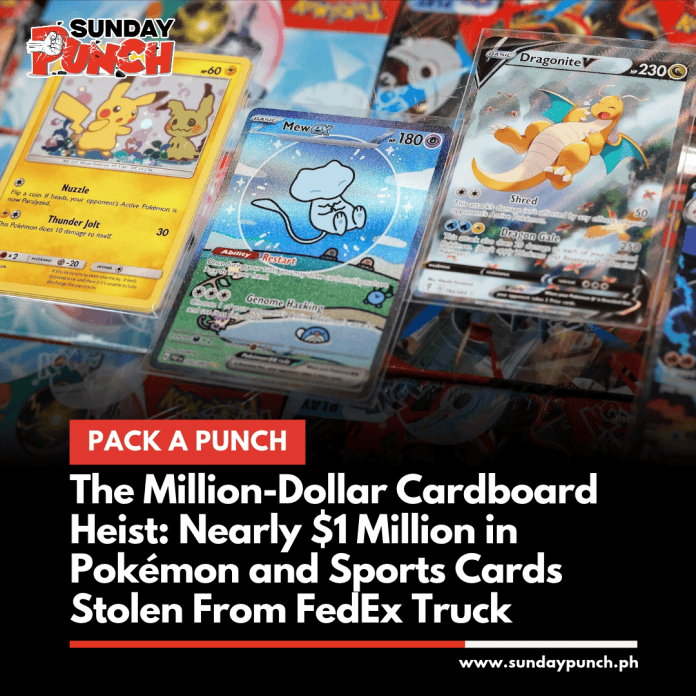
What was once a childhood hobby involving colorful cardboard, pocket money, and playground trades has become valuable enough to attract criminals targeting shipments worth nearly a million dollars. Police in Santa Ana, California, are investigating the theft of an estimated $963,000 worth of collectible trading cards from a FedEx truck on October 13, including rare Pokémon and sports cards belonging to collectors across the United States. The incident highlights a striking transformation in the collectibles industry: items once exchanged between children for fun now command prices comparable to luxury vehicles, real estate, and other high-value assets. Apparently, the old Pokémon slogan about catching them all has taken on a considerably more expensive—and criminal—interpretation.
According to the Santa Ana Police Department, thieves broke into a FedEx truck parked near the headquarters of Professional Sports Authenticator (PSA), a company specializing in authenticating and grading collectible cards. Two full pallets of trading cards were stolen, while additional items were taken from a third. Police placed the preliminary value of the stolen property at approximately $963,000, although the final amount has yet to be determined. The shipment contained hundreds of cards submitted by collectors for professional grading, a process that evaluates authenticity and condition and can influence a card’s resale value. No arrests had been announced as of October 20, and authorities were continuing their investigation. The circumstances surrounding the theft have not yet established who was responsible or whether the perpetrators specifically knew which valuable cards were inside the vehicle.
Among those affected was a collector known online as Sky-B Cards, who said that 104 cards he had accumulated over approximately two years were included in the stolen shipment. He reported spending more than $8,000 on grading services and having insurance coverage exceeding $150,000 for his collection. However, his greatest concern extended beyond the financial loss. Some cards were rare or individually unique, making them particularly difficult—or potentially impossible—to replace. His experience exposes a less obvious consequence of the booming collectibles market: while insurance may compensate owners for an estimated monetary value, it cannot necessarily restore the time, effort, personal attachment, or rarity associated with a collection. A card may have a market price, but that does not mean another identical copy can simply be ordered when it disappears.
The theft also raises questions about how the collectibles industry protects merchandise that has evolved into a lucrative alternative asset market. Collectors increasingly rely on professional grading companies, specialized shipping services, authentication certificates, and insurance to establish and protect the value of their possessions. Yet the Santa Ana incident demonstrates that valuable items can remain vulnerable while moving between these services. Collectors, PSA’s parent company, said it had deactivated the certification numbers associated with the stolen cards and alerted marketplace partners to watch for rare or serialized items. The company also said it was contacting affected customers to arrange compensation based on fair market value, while FedEx confirmed its cooperation with law enforcement. These responses may help identify stolen items and address financial losses, but they also underline an uncomfortable contradiction: cards can be meticulously authenticated, sealed, graded, and insured, yet still disappear during the journey back to their owners.
The incident follows other reported thefts targeting high-value trading cards, including burglaries at collectible stores in California and Illinois earlier this year. The growing financial appeal of rare Pokémon and sports cards has created opportunities for investors, dealers, and collectors, but it has also increased the potential rewards for theft. That does not mean collecting itself is unsafe or that rising prices inevitably cause crime; rather, valuable merchandise requires security arrangements appropriate to the risks involved. Ultimately, the Santa Ana heist illustrates how far the trading card industry has moved from its origins as a recreational hobby. For some collectors, the cards represent major financial assets. For others, they preserve years of memories, personal milestones, and the satisfaction of building something rare. Nearly a million dollars may describe the estimated value of the stolen shipment, but for the people who spent years assembling those collections, the loss may be far harder to calculate. The market has learned how to put extraordinary prices on pieces of cardboard. Protecting everything those pieces represent is proving to be a much more complicated challenge.
Image from Mario Tama/Getty Images