
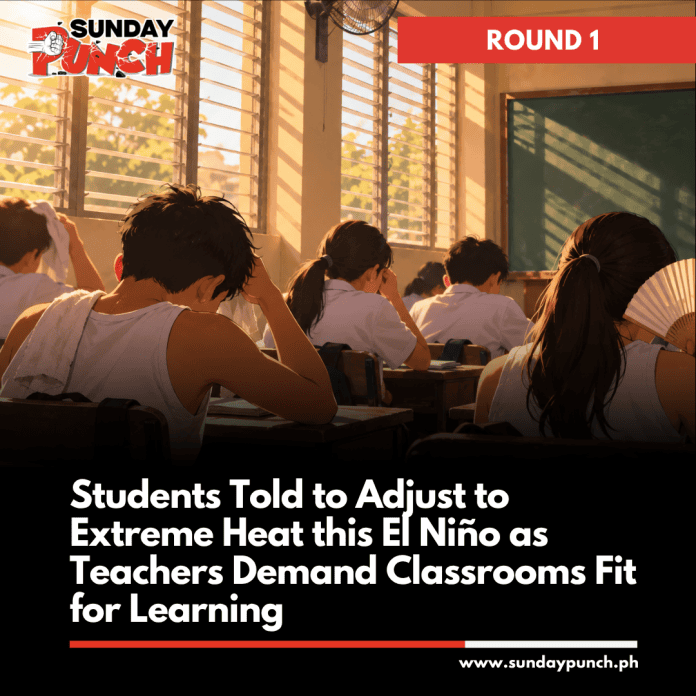
Students may soon be allowed to wear sleeveless shirts instead of school uniforms to cope with extreme heat, but a teachers’ group is questioning why the burden of adjusting to uncomfortable classrooms continues to fall on the people expected to learn and work inside them. The Teachers’ Dignity Coalition (TDC) urged the Department of Education (DepEd) on October 19 to look beyond clothing restrictions as the Philippines prepares for a potentially very strong El Niño. The issue, according to the group, is not simply whether students can wear lighter clothes, but whether schools can provide safe, healthy, and conducive environments for learning. After all, loosening a dress code may make a classroom more bearable, but it does not make the classroom itself any cooler.
Education Secretary Sonny Angara announced on October 16 that public school students would no longer be required to wear uniforms, allowing more comfortable clothing, including sandos, provided they remain reasonably appropriate for school. The adjustment acknowledges the discomfort students face in poorly cooled classrooms, but TDC warned that unclear implementation guidelines could create confusion and additional expenses for families. The group called for formal policies covering both students and teachers, alongside shorter class hours and hybrid learning arrangements when necessary. The irony is difficult to overlook: instead of students and educators being provided with consistently comfortable learning environments, they are being asked to modify how they dress and potentially how they attend classes to accommodate the conditions inside school buildings.
The concern is particularly urgent as the Philippine Atmospheric, Geophysical and Astronomical Services Administration (PAGASA) forecasts that the ongoing El Niño could intensify into a very strong event before the end of 2026 and persist into the first half of 2027. The country has already experienced the educational consequences of extreme heat. According to DepEd figures cited by Philstar.com, more than 4,000 schools suspended face-to-face classes in April 2024, affecting over 2.4 million students. Although the academic calendar has since returned to a June opening to avoid the traditionally hottest months, the anticipated intensification of El Niño during the school year presents another challenge. Changing the calendar and relaxing uniforms may provide temporary relief, but neither measure alone guarantees that classrooms will remain suitable for learning.
TDC also cautioned against relying entirely on online or modular learning, noting that students without reliable internet connections, digital devices, or appropriate study spaces at home could be placed at a disadvantage. The group instead called for investments in ventilation, cooling systems, renewable energy, and air-conditioning where feasible. DepEd, for its part, has acknowledged the problem, with Angara discussing additional solar installations and the possibility of dismissing students when heat conditions become dangerous. These measures indicate that the department is considering responses beyond clothing policies, although the scale and implementation of long-term improvements remain important questions. The challenge is avoiding a situation where students must choose between enduring uncomfortable classrooms and studying at home without adequate resources. Neither should be treated as an acceptable substitute for a safe educational environment.
Ultimately, the controversy raises a broader question about the responsibilities of the education system in an increasingly unpredictable climate. Students are expected to attend classes, concentrate, participate, and perform academically, while teachers are expected to deliver effective instruction. Those expectations should be matched by learning environments that support the people inside them. Allowing lighter clothing is a practical adjustment, but it cannot replace investments in facilities capable of withstanding extreme weather. El Niño may be beyond the government’s control, but the quality, safety, and resilience of public school infrastructure are matters of policy and planning. Students can change their uniforms. They cannot change the temperature of an entire classroom—and they should not be expected to carry that responsibility themselves.